Shared Hosting
  WordPress Hosting
  Cloud VPS Hosting
  Dedicated Servers
Game server hosting is not just about buying the plan with the most RAM.
RAM matters, but it is only one piece of the setup. A good game server also depends on CPU performance, player count, storage speed, network quality, DDoS protection, and where the server is located compared to the players.
That is why two servers with the same amount of memory can feel completely different in-game. One may run smoothly. The other may lag, rubber-band, or struggle when players explore new areas, add mods, or join at the same time.
This guide keeps it simple. Here is what kind of server you should choose for game hosting, when a VPS is enough, when a dedicated server makes more sense, and why location can matter more than people expect.

Game Server Hosting: Quick Recommendation Table
If you want the short version, start here.
Start With the Game, Not the Server
Different games behave very differently on a server.
A small Valheim server for a few friends is not the same as a busy Rust server. A vanilla Minecraft server is not the same as a heavily modded Minecraft server. A private server with five players is not the same as a public community with unpredictable traffic.
Before choosing a plan, think about the actual use case:
- Which game are you hosting?
- How many players will join at the same time?
- Will you use mods or plugins?
- Will the server be private or public?
- Where are most players located?
- Do you need DDoS protection?
Those answers matter more than simply saying “I need a game server.”
If Minecraft is the game you are planning around, our Minecraft server hosting guide goes deeper into vanilla servers, Paper, Fabric, Forge, RAM, and when VPS or dedicated hosting makes sense.
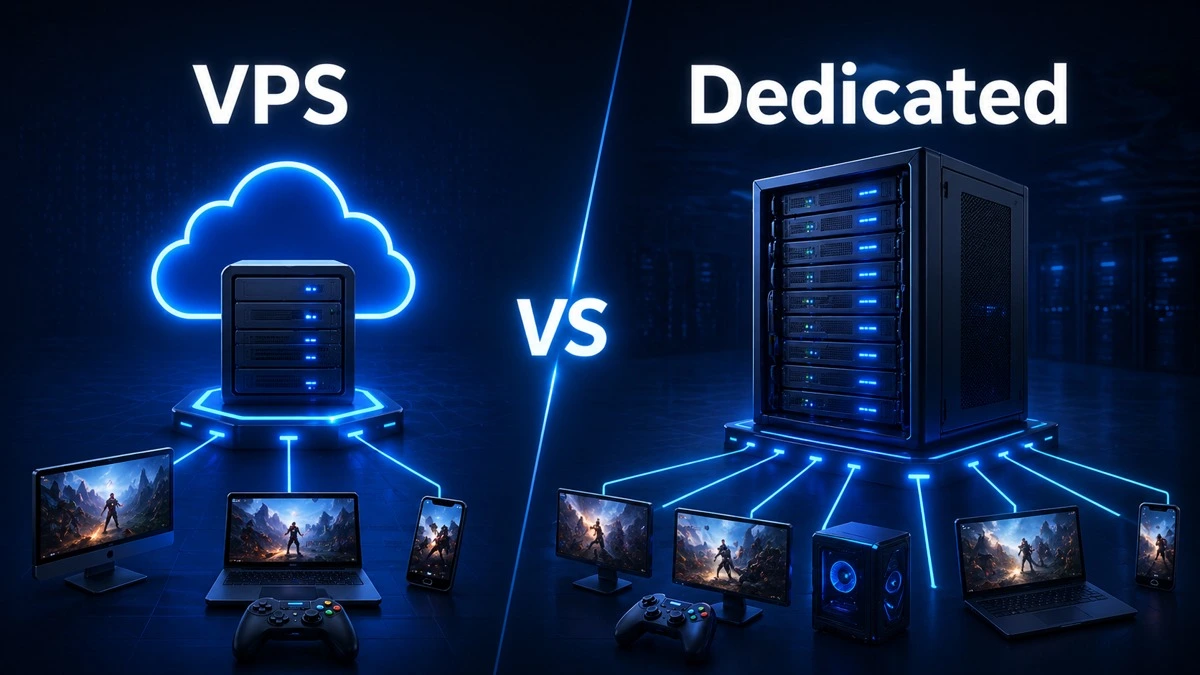
When a VPS Is Enough for Game Hosting
For many small game servers, a VPS is the best starting point.
A VPS gives you your own virtual server with root access, dedicated resources depending on the plan, and enough flexibility to install and manage the game server yourself. It is usually cheaper than a dedicated server and easier to scale when you are still figuring out what you need.
A VPS is usually a good fit for:
- small private servers
- friend groups
- casual Minecraft servers
- Valheim servers
- Project Zomboid servers
- testing plugins, mods, or maps
- smaller communities that do not need a full machine
The main advantage is simple: you get control without paying for more server than you need.
The main limit is also simple: a VPS still runs on shared physical infrastructure. A good VPS can perform very well, but for larger public servers or very CPU-heavy games, a dedicated server can be more predictable.
When You Should Choose a Dedicated Server
A dedicated server makes sense when the game server is important enough that you want the whole machine available to you.
That does not mean every game server needs dedicated hardware. Many do not. But once you are running a larger public server, a mod-heavy setup, or a game that consistently uses a lot of CPU and memory, dedicated hardware becomes much easier to justify.
Choose a dedicated server if:
- you expect a larger player count
- the server will be public
- you are running heavy mods or plugins
- you need more predictable performance
- you want to avoid noisy-neighbor effects
- you need stronger long-term stability
- DDoS protection is important
Dedicated servers are especially useful for games where performance spikes can ruin the experience for everyone. If players are joining, fighting, building, generating worlds, or running mods at the same time, predictable resources become more valuable.
RAM Matters, But CPU Often Matters More
RAM is important because it gives the game server room to hold world data, players, mods, and active processes in memory. If you do not have enough RAM, the server may crash, freeze, or start using swap, which is bad for performance.
But once you have enough RAM, adding more does not automatically make the server feel faster.
Many game servers depend heavily on CPU performance. Some games rely strongly on single-core performance, which means a server with fewer but stronger CPU cores may feel better than a server with lots of weaker cores.
This is why a game server can still lag even when memory usage looks fine. The real bottleneck may be CPU load, world generation, plugins, or the game engine itself.
A simple way to think about it:
- RAM helps prevent memory problems.
- CPU helps decide how smoothly the server runs under load.
- Storage affects loading, saving, and world data.
- Network affects how responsive the server feels to players.
Location Can Matter More Than Specs
For game hosting, server location is not just a privacy or branding choice. It directly affects how the game feels.
If most players are in Northern Europe and the server is far away, players may notice higher ping, delayed actions, rubber-banding, or slower response during combat. Even a powerful server can feel bad if the location is wrong.
The best location is usually the one closest to most players, with good routing and a stable network.
Simple location rules:
- Mostly Nordic, Baltic, or Northern European players: choose Finland.
- Mostly Central or Western European players: choose Switzerland or another central European location.
- Mixed European player base: test ping from several locations before deciding.
- Mostly US players: choose a US location, not Europe.
- Global audience: optimize for your main player base, because no single location is perfect for everyone.
Do not choose a server location just because it sounds impressive. For gaming, the best location is usually the one that gives the largest share of your players the lowest and most stable ping.
Storage and Network Quality Still Matter
Storage is easy to overlook until the game starts saving, loading chunks, updating maps, or handling large world files.
SSD or NVMe storage is strongly preferable for most modern game servers. It helps with world loading, faster saves, updates, backups, and general responsiveness.
Network quality matters too. For private servers with friends, a stable connection may be enough. For public servers, DDoS protection becomes much more important. Public game servers can attract abuse, and even a short attack can ruin a session for everyone connected.
A good game server setup should have:
- enough RAM for the game and player count
- strong CPU performance
- SSD or NVMe storage
- a location close to most players
- stable network routing
- DDoS protection for public servers
The Simple Recommendation
If you are hosting a small private game server for friends, start with a VPS. It is usually the most practical choice. You get control, flexibility, and enough power for many smaller game servers without paying for a full dedicated machine.
If you are hosting a larger public server, a mod-heavy setup, or a game where performance has to be stable under load, choose a dedicated server. The higher cost is easier to justify when the server is important to a community.
If you are unsure, start smaller and measure. Watch CPU usage, RAM usage, disk activity, and player feedback. If the server struggles under real use, upgrade based on the actual bottleneck, not guesses.
Quick Checklist Before You Choose
- Start with the game and player count.
- Do not choose based on RAM alone.
- Prioritize CPU performance for smooth gameplay.
- Use SSD or NVMe storage.
- Choose the location closest to most players.
- Use a VPS for small private servers.
- Use a dedicated server for larger public or heavy servers.
- Make sure public servers have DDoS protection.
Final Thoughts
The best server for game hosting is not always the biggest one.
It is the one with the right mix of CPU, RAM, storage, network quality, and location for the game you actually want to run.
For small groups, a VPS is often the smartest starting point. For larger communities, heavy mods, or public servers, a dedicated server is usually the safer long-term choice. And for every game server, location matters. A well-placed server with solid resources will usually feel better than an oversized server in the wrong region.
Game server hosting is really about matching the server to the players. Get that right, and the experience feels smoother before you even start adding more power.