Shared Hosting
  WordPress Hosting
  VPS Hosting
  Dedicated Servers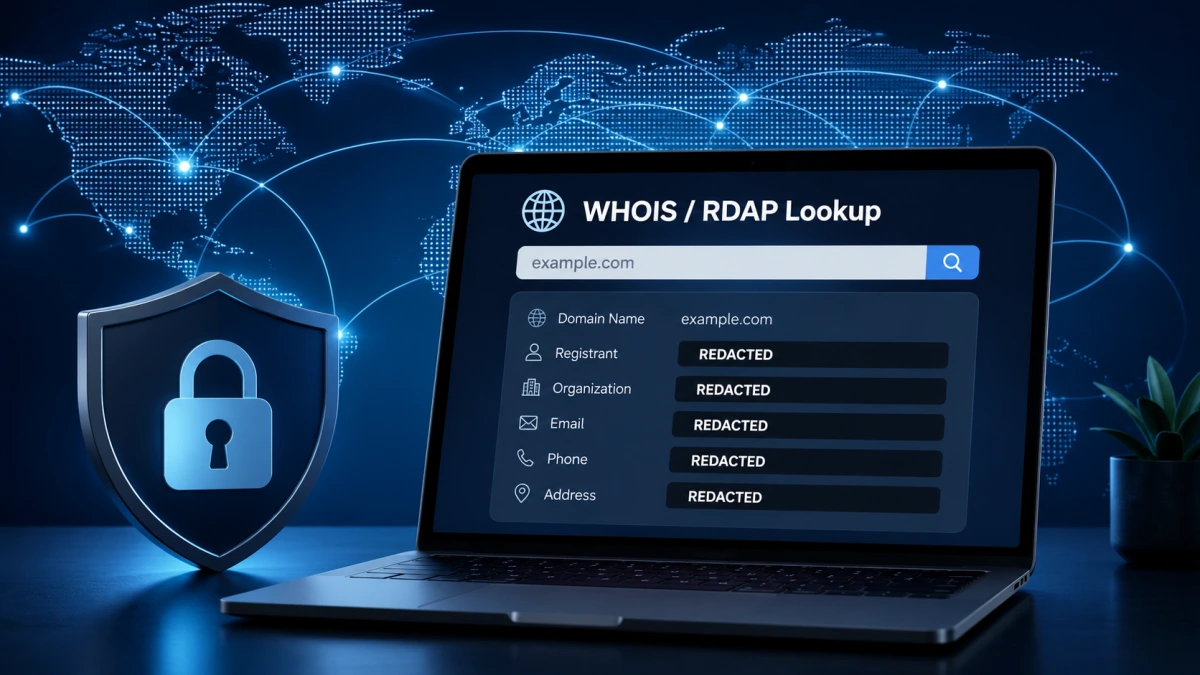
Most advice on domain extensions privacy treats WHOIS protection as a simple checkbox: pay a few euros a year, and your name and address disappear from public lookups. That is true for some extensions and false for others. A handful of registries hide registrant data by default, with no add-on involved. On others, what gets published depends entirely on whether you register as an individual or as a company. The extension you pick, and how you register on it, sets your baseline privacy. The registrar is a smaller factor than most buying guides suggest.
We have written before about how a hosting provider's jurisdiction shapes what can be demanded of your data in our Hosting Jurisdiction Index. The same logic applies to domain registries, and it is usually the more overlooked half of the privacy picture.
What Domain Extensions Privacy Actually Means
When you register a domain, ICANN and most country-code registries require a registrant contact: a name, an email address, sometimes a phone number and postal address. By default, a portion of that becomes publicly searchable through WHOIS or its newer replacement, RDAP.
WHOIS privacy, where it is offered as a service, replaces those public fields with a forwarding address or a placeholder such as "REDACTED FOR PRIVACY." What it does not do is remove your details from the registrar's or registry's own records. Your registrar still knows who you are. The registry still holds your contact information on file. A valid legal request can still reach it. WHOIS privacy stops casual lookups, scrapers, and spam. It does not stop a court order.
If what you are after is minimizing what you hand over in the first place, that is a separate question from WHOIS privacy, and one we cover in how anonymous domain registration actually works.
Extensions Where the Registry Protects You by Default
Three of the extensions we sell need no privacy add-on, because the registry already withholds registrant data as a matter of policy.
| Extension | Price / year | How privacy works |
|---|---|---|
| .ch | €15.90 | Registry withholds name and address by default |
| .li | €12.00 | Same non-public lookup model, operated by SWITCH |
| .is | €126.90 | Registry limits individual fields by design |
.ch (Switzerland). Since January 1, 2021, under a revision to Switzerland's Ordinance on Internet Domains, the registry SWITCH no longer publishes the name and postal address of .ch domain holders through its directory service. That data is released only to a party who can show an overriding legitimate interest, such as a trademark dispute or a law enforcement request through proper channels. At €15.90 a year, it is one of the least expensive domains on our list and one of the strongest defaults.
.li (Liechtenstein). Operated by SWITCH and covered by the registry's non-public holder-data lookup model. At €12.00 a year, it is the cheapest domain we sell.
.is (Iceland). Registration is open to anyone worldwide, no residency requirement. The registry, ISNIC, automatically hides the name, email address, identification number, phone number, and street address of registrants classified as individuals, leaving only the country visible unless the holder chooses to publish more. Organizations may be treated differently under ISNIC's rules. At €126.90 a year it is priced more like a boutique ccTLD than a value pick.
Extensions Where Privacy Depends on Registrant Type
.de and .eu do not sort neatly into "private" or "public." Both registries publish a different amount of data depending on whether you register as an individual or as an organization, and both have tightened their rules recently under the EU's NIS2 Directive, which began taking effect in December 2025.
| Extension | Price / year | Individual | Organization |
|---|---|---|---|
| .de | €14.00 | Not published | Name, address, email, phone all published |
| .eu | €28.90 | Email and language only | Company, city, region, country, email, language |
.de (Germany). DENIC withholds the name, address, email, and phone number of a domain holder from public WHOIS whenever the holder is a private individual, and that protection is the default, not an add-on. Companies and other legal entities are published in full, a line Germany's implementation of the NIS2 Directive has enforced more strictly since December 2025. At €14.00 a year, .de is a strong pick if you are registering as yourself and a weak one if you are registering as a company hoping to stay private.
.eu. EURid lets you register as either an individual or an organization, and the choice determines what is public. Individuals have their email address and language shown, nothing more. Organizations have their company name, city, region, country, email, and language shown. Eligibility runs wider than the EU itself: citizens and residents of Iceland, Liechtenstein, and Norway can also register, under the EEA extension of the .eu regulation. At €28.90 a year, .eu works well for an individual and offers no real privacy for a business.
Open ccTLDs With Their Own Registry Privacy Rules
.nl and .se are open to anyone, no residency required, and both handle privacy at the registry level rather than through a registrar add-on. Neither fits the generic gTLD model below, so they get their own category.
| Extension | Price / year | Individual | Organization |
|---|---|---|---|
| .nl | €20.90 | Name and address withheld, admin email shown | Name shown, address optional |
| .se | €46.00 | No contact details shown | Fully published |
.nl (Netherlands). SIDN has withheld a private registrant's name and address from public WHOIS since 2010, showing only an administrative contact email. That made privacy and proxy services pointless, so SIDN banned them outright in October 2023, a domain must now be registered in the name of its real holder. Business registrants have their name shown by default and can choose to add an address. At €20.90 a year, .nl is a solid individual pick with the caveat that you cannot layer a proxy service on top of it.
.se (Sweden). Internetstiftelsen, the .se registry, shows no contact details at all in public WHOIS when the holder is registered as a private individual or a sole trader. Businesses and other legal entities are published in full. At €46.00 a year, it is a genuine registry-level privacy pick if you are registering personally rather than as a company.
The Rest: Open Registration Under ICANN's Framework
The remaining extensions we sell are gTLDs, generic top-level domains governed directly by ICANN rather than a national registry. Since August 21, 2025, these operate under ICANN's Registration Data Policy, which replaced the Temporary Specification that GDPR forced into place in 2018. Registrars and registries are required to limit what personal data reaches public WHOIS or RDAP output. That requirement is closer to a compliance obligation than a purchasable privacy product, though a registrar can still layer a proxy service on top of it for whatever fields remain.
This covers .com, .net, .org, .io, .dev, .app, .me, .co, .biz, .info, .pro, .club, .online, .site, .tech, and .shop.
| Extension | Price / year |
|---|---|
| .com | €17.90 |
| .net | €21.00 |
| .org | €27.90 |
| .io | €91.90 |
| .dev | €21.00 |
| .app | €23.00 |
| .me | €51.00 |
| .co | €55.90 |
| .biz | €38.00 |
| .info | €54.90 |
| .pro | €54.90 |
| .club | €53.00 |
| .online | €72.00 |
| .site | €61.90 |
| .tech | €119.90 |
| .shop | €74.90 |
None of these are a bad privacy choice. The protection here comes from ICANN policy rather than the registry going further on its own, which is the real distinction between this group and .ch, .li, .is, .nl, and .se.
Frequently Asked Questions
Does WHOIS privacy hide my domain from law enforcement?
No. WHOIS privacy only affects what is publicly visible through a WHOIS or RDAP lookup. Your registrar and the registry keep your actual contact information on file, and a valid legal request can still reach it.
Which domain extensions have free WHOIS privacy by default?
.ch, .li, and .is withhold registrant data as a matter of Swiss, Liechtenstein, and Icelandic registry policy. .nl and .se do the same specifically for private individuals and sole traders. None of these require a paid add-on.
Can I get privacy on a .de or .eu domain?
Yes, if you register as an individual. DENIC withholds a private holder's contact details entirely, and EURid limits an individual's public record to an email address and language. Register as a company on either extension and your contact details are published in full.
Is .com or .ch better for privacy?
.com relies on ICANN's Registration Data Policy, which a registrar applies on your behalf and could, in principle, change. .ch's redaction is set in Swiss regulation at the registry level, independent of which registrar you use.
Registering With Packetra
Every Packetra domain registration includes free WHOIS privacy on any extension that permits it, along with free DNS management and email forwarding. You do not need hosting with us to register or transfer a domain. Payment is available in EUR, USD, GBP, CAD, AUD, or Bitcoin. Paying with Bitcoin avoids attaching a card or bank payment record to the purchase, though the registrar and registry still collect whatever information the extension itself requires.