Shared Hosting
  WordPress Hosting
  Cloud VPS Hosting
  Dedicated Servers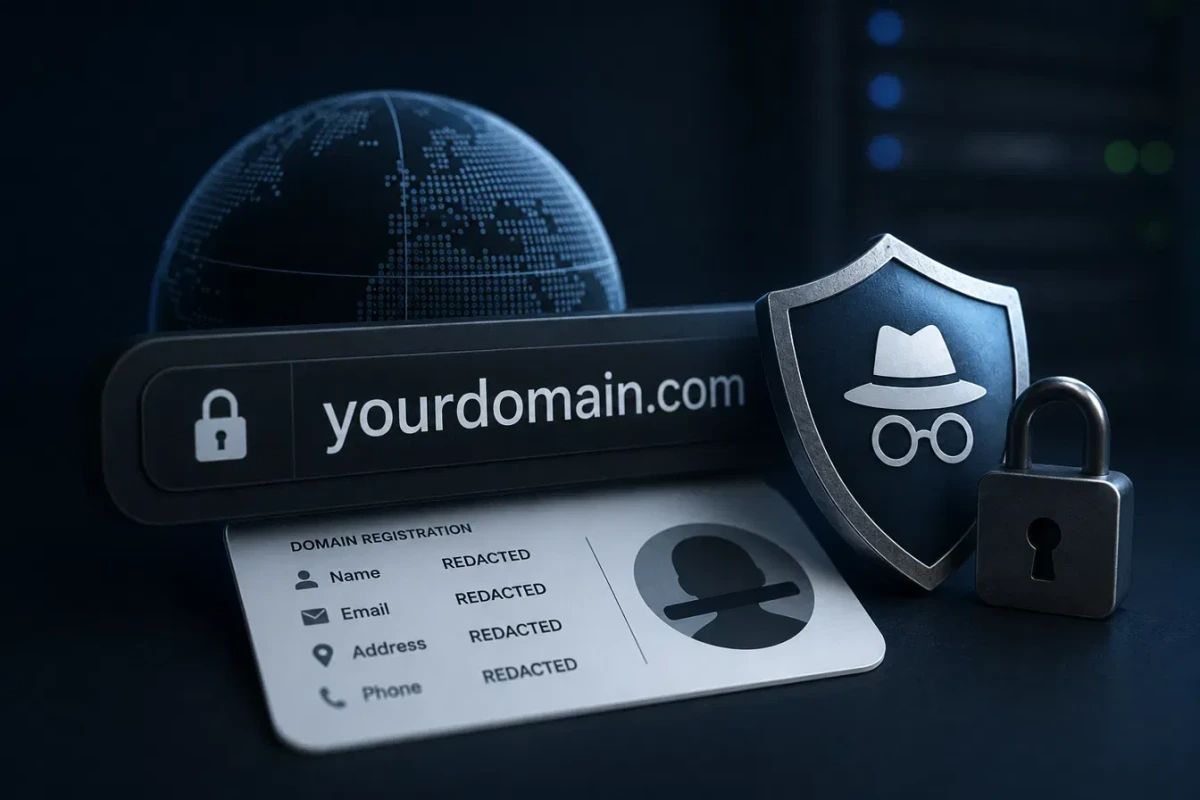
Anonymous domain registration is one of the most misunderstood parts of setting up a private website. The domain is usually the first thing bought and the first place identity leaks, often before the site even exists.
This guide explains what anonymous domain registration can and cannot hide, what the rules require from you and your registrar in 2026, and how to register a domain anonymously, step by step.
The short version
Someone always holds the contact details behind a domain. Anonymous domain registration keeps those details out of public view, keeps what the registrar knows to a minimum, and keeps the purchase from pointing back to you. That takes three things together: a registrar that asks for no ID, a payment method that is not tied to your name, and WHOIS privacy on an extension that allows it.
Where domains leak identity
Every domain registration collects registrant details: a name, a postal address, an email address and a phone number. For years this went straight into the public WHOIS database, where anyone could look it up. That era is mostly over, but the data still exists. The registrar holds it, and for many extensions so does the registry that runs the extension. The question is never whether the data exists somewhere; it is who holds it, how much of it identifies you, and who can see it.
There is also a second leak that gets less attention: payment. A domain bought with a personal card is tied to a bank identity regardless of what the public record shows. Privacy on the registration form means little if the payment trail points straight back to the buyer.
| Where your details sit | Who can see them | What reduces the exposure |
|---|---|---|
| Public lookup (WHOIS / RDAP) | Anyone | WHOIS privacy, or an extension whose registry hides private holders |
| Registrar's records | The registrar, and anyone with a court order or an accepted disclosure request | A registrar that asks for no ID, and a dedicated email address |
| Registry's records | The registry, for extensions that store contact data | Choosing the extension deliberately |
| Payment records | Your bank or card company and any payment processor | Paying in crypto, ideally Monero |
| The website itself | Every visitor | No names, no reused email addresses, no third-party trackers |
What changed: from WHOIS to RDAP
If you last looked at this a few years ago, the rules have moved. These are the changes that matter for anonymous domain registration today.
- 2018: redaction became the norm. When the EU's GDPR took effect in May 2018, ICANN, which sets the rules for generic extensions such as .com, adopted a Temporary Specification requiring registrars to stop publishing personal data where GDPR applies. Most registrars chose to apply it to everyone, so most public records now show "REDACTED" instead of a name and address.
- January 2025: RDAP replaced WHOIS. Since 28 January 2025, the Registration Data Access Protocol (RDAP) has been the definitive source of registration data for generic extensions, in place of the old WHOIS service. Most people still say "WHOIS", and so does this guide.
- August 2025: a permanent policy. ICANN's Registration Data Policy took effect on 21 August 2025 and replaced the interim rules. It sets how registration data is collected, redacted and disclosed, and requires registrars to respond to requests for the hidden data within 30 days of acknowledging them, absent exceptional circumstances.
- A standard way to ask for hidden data. Since November 2023, ICANN's Registration Data Request Service has given law enforcement, intellectual property professionals, cybersecurity professionals and government officials a standard route for requesting non-public data. Disclosure is not guaranteed, but the route exists.
- In the EU: NIS2. Article 28 of the NIS2 Directive requires EU countries to make TLD registries and the companies that sell domain registrations keep accurate and complete registration data, have verification procedures in place, and answer lawful requests from legitimate access seekers within 72 hours. How strictly identities are checked varies by country and registry.
The takeaway: redacted does not mean deleted. In 2026, anonymous domain registration is about what goes into the record in the first place, not only about hiding it afterwards.
What WHOIS privacy does and does not do
Most registrars offer WHOIS privacy, sometimes called domain privacy protection or ID protection. It replaces your details in the public record with those of the registrar or a privacy service, or with a placeholder. It is useful and worth having, but it is a thinner layer than the name suggests.
WHOIS privacy hides registrant details from public lookups. It does not remove them from the registrar's records, it does not hide the payment method, and it can be lifted: by legal process, by a disclosure request, in a domain dispute, or by registry policy on some extensions. Under ICANN's rules, a registrar's own privacy service must also keep its customers' underlying details in data escrow. So WHOIS privacy is the visible layer of anonymous domain registration, not the whole of it.
What a registrar can require from you
For generic extensions, ICANN's Registrar Accreditation Agreement sets the ground rules, and they are worth knowing before you register anything:
- Accurate contact details. You must give accurate and reliable contact details and update them within seven days of any change.
- Email or phone verification. The registrar must verify your email address or phone number within 15 days of registration and suspend domains that are not verified in time.
- No invented details. Knowingly giving false information is a material breach of your contract and grounds for suspending or cancelling the domain.
- No ID requirement from ICANN. ICANN's rules do not require you to send a passport or other ID. Some registrars and some country-code registries ask for one anyway, which is exactly what to check before you sign up.
This is why fake names are a bad plan. A domain registered to an invented person can be suspended as soon as anyone reports it, and you cannot prove it is yours in a dispute. The workable approach is a registrar that asks for no ID, a dedicated email address, and privacy on top.
The one way to keep your name out of the registrar's records entirely is a proxy or nominee service, where the provider registers the domain in its own name and lets you use it. That moves the trust question onto the provider, and it means you are not the legal holder of the domain. Under the same agreement, a provider that lets someone else use a domain registered in its name accepts liability for harm caused by it unless it discloses who that someone is, so these services may reveal a customer who is shown to be causing harm. Our guide to domain seizure covers the trade-offs of nominee ownership.
Which domain extensions allow privacy
The extension you choose decides a lot before any other step. Generic extensions such as .com, .net and .org allow WHOIS privacy. Some country codes forbid it: the .us registry does not allow privacy or proxy registrations at all, so the registrant's details are public. Many European country codes take a third route and hide private individuals' details by default while publishing those of companies.
Our guide to domain extensions and privacy goes through the extensions one by one.
How to register a domain anonymously, step by step
Anonymous domain registration comes down to eight steps, done in this order.
1Create an email address just for the domain
Use a new address that is not linked to your name, your phone number or your other accounts, and protect it with a strong password and two-factor authentication. This address is the key to the domain: the registrar verifies it, sends renewal notices to it and uses it to reset access. Lose it and you can lose the domain.
2Choose an extension that allows privacy
Pick a generic extension such as .com, or a country code whose registry hides private holders by default. Avoid extensions that ban privacy, such as .us, and check any residency or eligibility rules before you buy.
3Pick a registrar that asks for no ID
Look at the signup form before you commit: an email address and a password is a good sign, a request for a passport or a selfie is not. Check where the company is based too, since that decides whose courts can reach it. Our comparison of the best anonymous domain registrars looks at the main options.
4Pay without your name
Monero is private by default. Bitcoin is not: every payment is public on its blockchain, and coins withdrawn from an exchange that knows your identity can be traced back to you. A registrar with its own self-hosted payment system also keeps a third-party processor out of the loop. Anonymous hosting with Monero explains the reasoning in more depth.
5Turn on WHOIS privacy and check it
Enable privacy at checkout if it is not on by default. Once the domain is live, look it up in a public RDAP tool such as ICANN Lookup to confirm that your details are hidden.
6Verify the email within 15 days
The registrar sends a verification email after registration. Confirm it, or the domain can be suspended.
7Lock the domain down
Turn on the registrar's transfer lock, use two-factor authentication on the registrar account, and renew for several years or switch on auto-renew. An expired domain is eventually released for anyone to register, and whoever takes it gets everything that still points to it.
8Point it at hosting bought the same way
Use hosting from a provider that asks as little as your registrar did, and pay for it the same way. The next section explains why.
None of these steps is difficult, and none of them requires anything exotic. What they require is treating the domain, the payment and the hosting as one decision instead of three unrelated purchases.
Why the hosting behind the domain matters
A common mistake is treating anonymous domain registration as the whole privacy problem. The domain is only the address. The site itself lives on hosting, and hosting has its own exposure points: the account details the host collects, the payment method used, and the jurisdiction where the server sits.
An anonymously registered domain pointed at hosting bought with a personal card, under a full legal identity, in a heavily logging jurisdiction, is a private front door on a glass house. The two purchases need to follow the same logic. For a personal site, a blog or a small project, that usually means privacy-focused shared hosting: the same email-only signup and crypto payment as the domain, without the cost or overhead of a full server. Our guide to anonymous web hosting covers what to look for.
Where the hosting is located matters too. Jurisdictions differ sharply on data retention, legal process and foreign reach, which is the subject of The Hosting Jurisdiction Index 2026. Finland and Switzerland both score well for different reasons, and the trade-offs between them are covered in Finland vs Switzerland Hosting in 2026.
Same provider or separate?
There is a practical argument for getting the domain and the hosting from the same privacy-focused provider: consistency. One email identity created for the project, one payment method, one set of privacy practices, instead of a private domain at one company and an identity-heavy hosting account at another.
The counterargument, popular in privacy circles, is separation: splitting domain and hosting across providers so no single company holds the full picture. Both approaches are defensible. Separation adds compartmentalization at the cost of managing two identities correctly; consolidation is simpler and leaves fewer chances to slip. For most people, a slip in operational discipline is a bigger risk than either arrangement, so the simpler setup done consistently tends to win.
What anonymous domain registration does not solve
The limits deserve the same honesty as the benefits. Anonymous domain registration reduces exposure at the point of purchase and in public records. It does not anonymize the website itself.
A site that names its owner, reuses an email address tied to other accounts, embeds third-party analytics or publishes identifying details in its content undoes the private registration in minutes. Registrars and registries can still be compelled through legal process. Some extensions do not allow privacy at all. And nothing at the domain layer protects careless server or account management. The pattern is the same one that applies to hosting: privacy tools reduce unnecessary exposure, they do not grant immunity, a distinction covered in Anonymous Hosting: What It Really Means in 2026.
Anonymous domain registration at Packetra
We built our domain registration around the same three layers. An account needs only an email address and a password, with no ID checks. Registrations, transfers and renewals can be paid in Bitcoin or Monero through our self-hosted BTCPay Server. WHOIS privacy is available on eligible generic extensions such as .com, .net and .org, and every domain comes with free DNS management on our own nameservers, with DNSSEC support.
To be clear about the limits: the registration itself is made in your name through our upstream registrar, as the rules above require, and country-code extensions follow their own registry's rules. If you want the website to share the same thin paper trail as the domain, our shared hosting is bought the same way.
FAQ
Is anonymous domain registration legal?
Yes, in most countries. Anonymous domain registration uses legal tools: WHOIS privacy, a registrar that does not ask for ID, and payment in crypto. What breaks the rules is knowingly giving false contact details, which is grounds for losing the domain, or trying to use privacy on an extension that forbids it, such as .us.
What is the difference between private and anonymous domain registration?
Private domain registration usually means WHOIS privacy: your details are hidden from the public record. Anonymous domain registration goes further and also limits what the registrar knows about you and whether the payment points back to you.
Can I register a domain with fake details?
You can type them in, but it breaches the registration agreement and gives the registrar a reason to suspend or cancel the domain. It also leaves you unable to prove the domain is yours if there is ever a dispute. Accurate details kept private are safer than invented ones.
Can WHOIS privacy be removed?
Yes. It can be lifted in response to a court order or an accepted disclosure request, in a domain dispute, or where a registry's rules do not allow it. It stops casual lookups, scrapers and spam, not legal process.
Is Cloudflare's free domain privacy enough?
Cloudflare Registrar redacts personal data from the public record for free where the registry allows it, which covers the public layer. It does not cover the other two: Cloudflare holds your details, billing is by card, digital wallet or PayPal, and the company is based in the US. Domains registered there must also use Cloudflare's nameservers. Our look at Cloudflare privacy covers what else Cloudflare can see.
Sources
- ICANN: Temporary Specification for gTLD Registration Data (adopted 17 May 2018)
- ICANN: Launching RDAP; Sunsetting WHOIS (27 January 2025)
- ICANN: Registration Data Policy Now in Effect (21 August 2025)
- ICANN: Registration Data Policy FAQs
- ICANN: 2013 Registrar Accreditation Agreement, sections 3.7.7.1 to 3.7.7.3 and the Whois Accuracy Program Specification
- ICANN: About Verification of Contact Information
- ICANN: Registration Data Request Service launch (28 November 2023)
- usTLD Privacy Services Policy
- Directive (EU) 2022/2555 (NIS2), Article 28
- Cloudflare developer documentation: Registrar WHOIS redaction, Registrar FAQ, and Billing profile pages
Last reviewed: 30 September 2026
Research note: This guide describes the rules published by ICANN, the .us registry and the EU at the time of review. Registry and registrar policies change, and country-code extensions follow national rules, so check the current terms of your registrar and extension before you register. This is general information, not legal advice.