Shared Hosting
 WordPress Hosting
 VPS Hosting
 Dedicated Servers
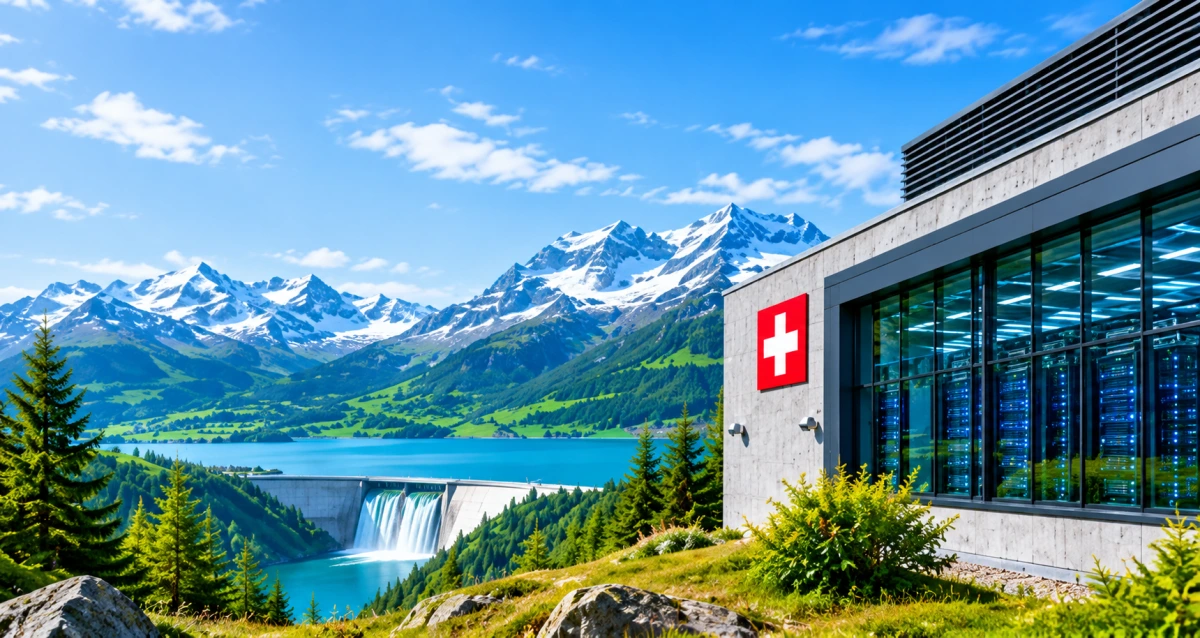
A Swiss data center puts your servers under Swiss law, on a power grid built mostly on hydropower, in one of the most stable countries in Europe. What it does not do on its own is decide who controls your data. That depends on the company running the servers inside the building. This guide covers where Switzerland's data centers are, what Swiss law covers, the catch with foreign cloud providers, and what to check before you choose hosting in one.
The short version
Switzerland has around 76 colocation data centers, most of the capacity around Zurich. Hosting in a Swiss data center puts the infrastructure under Swiss jurisdiction, outside the EU. But location is only half the question: a provider subject to US jurisdiction can be compelled through valid US legal process to disclose data it controls, even when that data is stored abroad. Check who runs the servers, not just where they stand.
Where Switzerland's data centers are
A market report published in March 2026 counted 76 existing colocation data centers in Switzerland, with 9 more planned, spread across 22 locations including Geneva, Lausanne, Basel, Bern, Lugano and Zug. Zurich is the clear hub, holding most of the existing and planned capacity. The largest operators named in the report are Green Datacenter, STACK Infrastructure, Digital Realty and Vantage Data Centers.
The large cloud platforms are there too. AWS opened its Europe (Zurich) region in November 2022, and Google Cloud and Microsoft Azure also run Swiss cloud regions. That matters for the section on control further down.
The sector is growing. A study for SwissEnergy, the federal energy programme, found that data centers in Switzerland used about 2.1 terawatt hours of electricity in 2024, roughly 3.6% of national consumption and 18% more than in 2019, with most of the growth in colocation and cloud facilities.
What a Swiss data center gives you
LawSwiss data protection and Swiss courts
The revised Federal Act on Data Protection (FADP) has been in force since 1 September 2023. A foreign authority that wants data from a server in Switzerland normally has to go through Swiss authorities under mutual legal assistance, and Switzerland is outside the EU. These safeguards do not displace the laws that bind the company operating the servers. Our guide to Swiss data protection law covers what the FADP protects.
PowerA grid built on hydropower
In 2025, hydropower produced 55.5% of Switzerland's domestic electricity and nuclear power 27.2%, according to the Swiss Federal Office of Energy. A particular data center's supply can differ from the national production mix, so ask the operator for documentation rather than assuming its energy comes from the same sources.
The catch: who runs the servers
A Swiss data center is a building. The company that runs the servers inside it is the one that holds your data, and that company carries its own legal obligations into the building.
Watch outA Swiss region of a US cloud is still a US provider
Under the US CLOUD Act of 2018, a provider subject to US jurisdiction can be compelled through valid US legal process, such as a warrant, to disclose data in its possession, custody or control, whether it is stored in the United States or abroad. Data in the Zurich region of a US cloud platform sits in Switzerland, but a US warrant can still reach the US company that controls it.
The same logic runs the other way for EU law. Being outside the EU does not automatically exempt a provider from the EU e-Evidence Regulation: providers that offer services in the EU and have a substantial connection to it can fall within its scope, wherever their servers are. Our guide to the EU e-Evidence Regulation explains how that works. Our Hosting Jurisdiction Index scores fourteen countries on the laws that matter for hosting.
What to check before you choose
1. Who runs the servers. Find out which company operates the hardware your data sits on, and which countries' laws bind it.
2. Where copies go. Backups, replicas and support tools can move data out of the country. Ask whether everything stays in Switzerland.
3. How legal requests are handled. A written policy that says whose court orders count is worth more than a general promise of privacy.
4. What the provider knows about you. If signup asks for your name, address and ID, that data sits in the provider's systems wherever your server is. Our guide to no-KYC hosting explains the difference.
5. Energy claims. If green power matters to you, ask for the data center's own documentation, not the national average.
Hosting in a Swiss data center with Packetra
Our Swiss shared and WordPress hosting runs in a Zurich data center, and our Swiss Cloud VPS and dedicated servers are hosted in Switzerland too. You can rent space on our servers rather than renting a rack yourself:
| Service in Switzerland | From | Good for |
|---|---|---|
| Shared hosting | EUR 26.50 for 6 months | Websites and email on your own domain |
| WordPress hosting | EUR 22.90 a month | WordPress sites with daily backups |
| Cloud VPS | EUR 13.90 a month | Full root access, unmetered 1 Gbit/s under fair use |
| Dedicated servers | EUR 163.90 a month | A whole machine to yourself |
Signup takes an email address and a password, with no ID. Bitcoin and Monero go through our own BTCPay Server, and you can also pay by card, PayPal or Wise. Under our acceptable use policy for Switzerland, copyright complaints need an order from a competent Swiss court or an enforceable order under an applicable treaty, and lawful adult content is permitted. Our guides to VPS hosting in Switzerland, dedicated servers in Switzerland and shared hosting in Switzerland go into each service, and Finland vs Switzerland compares our two locations.
FAQ
How many data centers are in Switzerland?
A March 2026 market report counted 76 existing colocation data centers and 9 planned ones. That figure covers commercial colocation sites, not the in-house server rooms that companies run for themselves.
Is data in a Swiss data center safe from foreign governments?
It is protected by Swiss law, and a foreign authority normally has to go through Swiss authorities to get it. That protection weakens if the company running your servers is bound by another country's law, as US providers are under the CLOUD Act. Swiss courts can also order data handed over.
Is Switzerland covered by the GDPR?
No. Switzerland is not in the EU, so its own data protection law, the FADP, applies to data centers there. A Swiss provider can still fall under the GDPR if it offers services to people in the EU.
Do Swiss data centers run on renewable energy?
The Swiss grid is dominated by hydropower, with nuclear power the second-largest source. Each data center's own mix depends on its supply contract, so ask the operator for documentation.
Do I need to rent rack space to use a Swiss data center?
No. Colocation means bringing your own hardware. If you only need a website, a mailbox or a server, hosting from a provider that already has servers there is simpler and cheaper.
Sources
- Research and Markets, 11 March 2026: Switzerland Colocation Data Center Portfolio Report and Database 2026
- Netzwoche, 7 May 2026: study for SwissEnergy on data center electricity use (German)
- Swiss Federal Office of Energy, 18 June 2026: Energieverbrauch 2025 leicht gestiegen (German; 2025 production mix)
- Amazon, 8 November 2022: AWS launches infrastructure region in Switzerland
- Skadden: Understanding the CLOUD Act's expansive reach (18 U.S.C. § 2713)
- Swiss Confederation, SME Portal: New Federal Act on Data Protection (nFADP)
- Regulation (EU) 2023/1543 (e-Evidence), EUR-Lex
- Packetra Swiss shared hosting, Swiss WordPress hosting and acceptable use policy for Switzerland
Last reviewed: 9 November 2026
Research note: The data center count comes from a commercial market report and covers colocation facilities only. Data center consumption is for 2024, from the study for SwissEnergy; the production mix is for 2025, from the Swiss Federal Office of Energy. Plan prices are taken from our product pages as of the review date. This article is general information, not legal advice.