Shared Hosting
 WordPress Hosting
 VPS Hosting
 Dedicated Servers
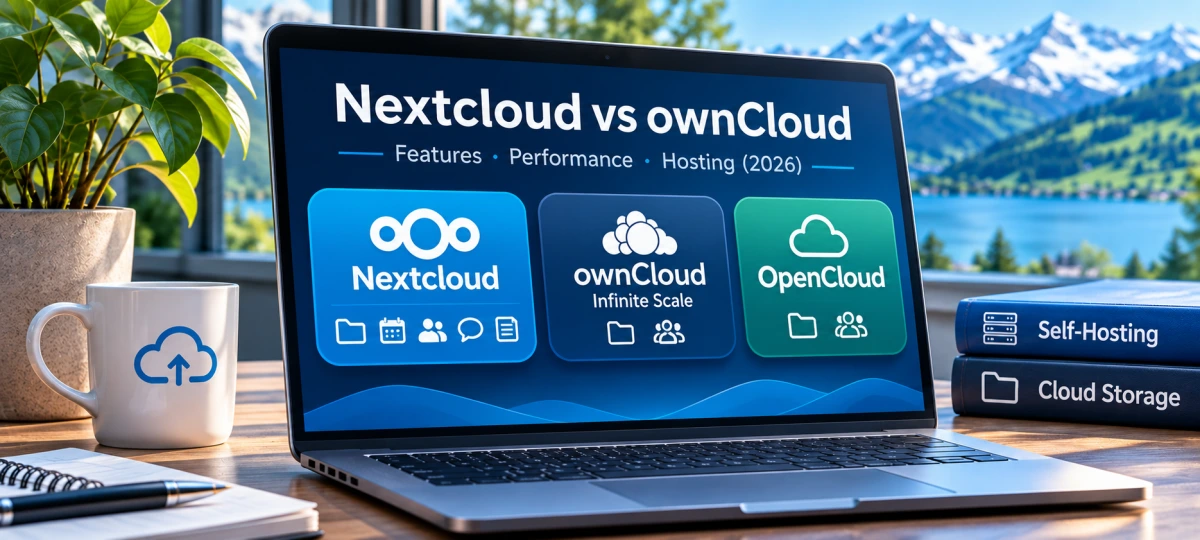
Nextcloud vs ownCloud used to be a choice between two close relatives. Nextcloud began in 2016 as a fork of ownCloud, led by ownCloud's founder Frank Karlitschek, and for years the two ran much the same PHP code. That is no longer the case. ownCloud has rebuilt its server in Go as ownCloud Infinite Scale, kept the old PHP server in maintenance, and been bought by Kiteworks, while a group of its former developers now build a third option called OpenCloud. This guide compares where each one stands in late 2026, and what each needs from the server you run it on.
The short version
The Nextcloud vs ownCloud choice comes down to scope. Pick Nextcloud if you want files, calendars, contacts, chat and office documents in one self-hosted suite. Pick ownCloud Infinite Scale or its fork OpenCloud if you want a lean file sync and sharing server with no database to manage. ownCloud Classic still gets updates, but it suits existing installs better than new ones. All of them run comfortably on a VPS, and storage, not processing power, is usually what decides the size of server you need.
How Nextcloud and ownCloud split
Frank Karlitschek started the ownCloud project in 2010. In 2016 he left the company he had co-founded and launched Nextcloud as a fork. Both products carried on as PHP applications for years after that, which is why older Nextcloud vs ownCloud comparisons treat them as near twins.
ownCloud then took a different path. With CERN, it rewrote its server from scratch in Go and released it as ownCloud Infinite Scale, with version 2.0 arriving in November 2022. In November 2023 the company was acquired by Kiteworks. In January 2025 the German Heinlein Group announced OpenCloud, a new company that forks the public Infinite Scale code, joined by more than a dozen former Infinite Scale developers; Kiteworks responded by threatening legal action.
The original PHP server, now called ownCloud Classic, is still maintained. It moved to an 11.x line requiring PHP 8.3 in July 2026, and Classic 11.1.0 followed in November 2026. In April 2026 ownCloud said it was keeping Classic secure and supported while customers plan their migration, that no major new features were planned for it, and that a migration tool from Classic to Infinite Scale was in development.
Nextcloud vs ownCloud compared
| Nextcloud | ownCloud Infinite Scale | OpenCloud | ownCloud Classic | |
|---|---|---|---|---|
| Written in | PHP | Go | Go | PHP |
| Database | MariaDB, MySQL or PostgreSQL | None needed | None needed | Required |
| Licence | AGPL-3.0 | Apache 2.0 (server) | Apache 2.0 (server) | AGPL-3.0 |
| Scope | Files plus calendar, contacts, chat, office, mail and hundreds of apps | Files, sharing and project spaces | Files, sharing and project spaces | Files and apps |
| Owned by | Nextcloud GmbH | Kiteworks | OpenCloud GmbH (Heinlein Group) | Kiteworks |
| Status | Several major releases a year; Hub 26 Summer in September 2026 | Current line is 8.x; 8.2.3 released 6 November 2026 | Active development since 2025 | Maintained; 11.1.0 released November 2026, focused on security and compatibility |
Features: a full suite or a lean file server
The biggest difference in Nextcloud vs ownCloud today is scope. Nextcloud has grown into a collaboration suite: file sync and sharing, calendars and contacts, Talk for chat and video calls, an office suite, mail, photos, project boards and an AI assistant, plus an app store for everything else. If you want one self-hosted replacement for Google Workspace or Microsoft 365, Nextcloud is the one built for it.
Infinite Scale and OpenCloud do less on purpose. They focus on file sync and sharing, with project spaces for teams, desktop and mobile clients, and integration with external office suites such as Collabora or ONLYOFFICE for editing documents in the browser. There is no database to run and back up separately, which makes them simpler to operate.
What each needs from a server
Nextcloud's documentation asks for at least 128 MB of RAM per PHP process and recommends 512 MB, with PHP 8.3 to 8.5 and a database, preferably MariaDB or PostgreSQL. SQLite works for testing and very small instances only.
On memory, Nextcloud vs ownCloud is closer than it looks. A lab comparison published in 2026 measured the gap in practice. On an empty server, Nextcloud sat at about 244 MiB of RAM at idle, against 67 MiB for Infinite Scale and 75 MiB for OpenCloud. Under load the difference narrowed: Nextcloud's peak was the lowest of the three at 685 MiB, against 743 MiB for OpenCloud and 864 MiB for Infinite Scale. The Go servers are lighter at rest, not necessarily under pressure.
Watch outStorage decides the server size
Your files live on the server's disk, so plan for how much you will store in a year, not how much you have today. Office editing, previews and video calls raise memory use well above the idle figures. For several terabytes, a dedicated server or an external object store fits better than a VPS disk.
Nextcloud vs ownCloud: which should you choose?
Best all-rounderNextcloud
For a household, a small business or anyone replacing a cloud office suite. The widest feature set, the largest community and frequent releases. The cost is more moving parts: PHP, a database and a cache to keep updated.
Lean and backedownCloud Infinite Scale
For file sync and sharing without the suite, from a vendor with enterprise customers. One Go service, no database, low memory at rest.
Lean and independentOpenCloud
The same lean design as Infinite Scale, developed by many of the people who built it, under an Apache licence and outside Kiteworks.
Existing installsownCloud Classic
If you already run it, keep it updated while you weigh your longer-term options. It still gets releases, but ownCloud has said no major new features are planned and is building a migration path to Infinite Scale, which is where it is investing for new deployments.
Running your own cloud on a VPS
Whichever side of Nextcloud vs ownCloud you land on, every option here runs on an ordinary Linux VPS. Our Cloud VPS are full KVM virtual machines, so Docker works, which covers the official Nextcloud All-in-One image as well as the single-container setups of Infinite Scale and OpenCloud. Point a domain at the server, put TLS in front of it, and keep backups somewhere other than the server itself.
As a starting point, a Cloud VPS #1 (1.5 GB RAM, 25 GB storage) can run a small Infinite Scale or OpenCloud install, and a #2 (3 GB, 40 GB) a lightweight Nextcloud with few users and apps. For Nextcloud All-in-One, which runs its own database, cache and helper containers, or for office editing and several active users, start at a #4 (7 GB, 80 GB). Real needs depend on the apps you enable, the number of users and how much you store. If storage outgrows that, our dedicated servers carry up to two 1.92 TB NVMe drives.
| Cloud VPS | RAM | Storage | Finland | Switzerland |
|---|---|---|---|---|
| #1 | 1.5 GB | 25 GB | EUR 9.90 a month | EUR 13.90 a month |
| #2 | 3 GB | 40 GB | EUR 15.90 a month | EUR 22.90 a month |
| #3 | 4 GB | 60 GB | EUR 22.90 a month | EUR 32.90 a month |
| #4 | 7 GB | 80 GB | EUR 32.90 a month | EUR 45.90 a month |
Running your own cloud in Switzerland or Finland means your files sit under Swiss or EU data protection law on a server you control, rather than with a US platform. Remember that whoever runs the hardware can technically read unencrypted data on its disks; our guide to what your hosting provider can see covers how to close that gap. Signup takes an email address and a password, and you can pay in Bitcoin or Monero through our own BTCPay Server. See our Cloud VPS plans, and our guide to what to do with a VPS for more ideas.
FAQ
Is Nextcloud a fork of ownCloud?
Yes. Nextcloud was forked from ownCloud in 2016 by ownCloud's founder, Frank Karlitschek. The two have developed separately since, and ownCloud's current server, Infinite Scale, shares no code base with Nextcloud, so a Nextcloud vs ownCloud comparison today is really a comparison of two different designs.
Is ownCloud still open source?
Yes. The Infinite Scale server is released under the Apache 2.0 licence and ownCloud Classic under the AGPL-3.0. Kiteworks also sells enterprise editions with extra features and support.
Which uses less memory, Nextcloud or ownCloud?
At rest, Infinite Scale and OpenCloud use a fraction of Nextcloud's memory. Under heavy use the gap closes, and in one 2026 lab test Nextcloud's peak was the lowest of the three.
Is Nextcloud vs ownCloud a privacy decision?
Less than people expect. Both keep your files on a server you choose. What decides your privacy is where that server is, who can access it, and whether sensitive data is encrypted. Nextcloud also offers end-to-end encryption for selected folders.
What is OpenCloud?
A fork of ownCloud Infinite Scale, launched in 2025 by the Heinlein Group and developed by many of the engineers who built Infinite Scale at ownCloud. It keeps the same lean, database-free design.
Sources
- Nextcloud admin manual: System requirements
- Nextcloud, 16 September 2026: Nextcloud Hub 26 Summer
- ownCloud Central, 3 November 2026: ownCloud Classic 11.1.0 and 10.16.7 are available
- ownCloud, 24 April 2026: PHP 8.3. Yes, for Classic.
- Versio.io: ownCloud Infinite Scale releases
- heise online, January 2025: Ex-ownCloud developers seek new start at OpenCloud
- Wikipedia: ownCloud (project history)
- ComputingForGeeks: OpenCloud vs Nextcloud vs ownCloud, 2026 lab test (memory figures and licences)
Last reviewed: 11 November 2026
Research note: Version numbers and release dates are as published at the review date and change often. Memory figures come from a single third-party lab test and will vary with your configuration and workload. VPS sizing suggestions are our own starting points, not vendor requirements.