Shared Hosting
  WordPress Hosting
  Cloud VPS Hosting
  Dedicated Servers
 Best Anonymous Domain Registrars in 2026
Search for anonymous domain registrars and you will mostly find pages written by registrars who put themselves at number one. It is worth saying plainly at the top: Packetra sells domains, we are in this comparison, and we are not claiming the top spot. Different setups need different answers, and for at least two of the situations below we are not the right pick.
There is also a terminology problem worth clearing up immediately, because it affects how you read everything below. Most of the well-known privacy options, ours included, are not the accredited registrar. They are resellers or intermediaries sitting on top of one. That is not a scandal, but it does add a company to the chain, and no comparison that ignores it is telling you the whole picture.
The four questions that actually decide this
1. What does the service ask you for?
The one every comparison covers. Can you sign up with just an email address, or does someone want a passport scan? Can you pay in a way that does not carry your name? It matters, but it is the easiest of the four to satisfy and the least meaningful on its own.
2. What reaches the registry regardless?
Some extensions require identity data by policy or by law, and nobody can register around that. A no-KYC service selling you a .eu does not make .eu's eligibility requirements disappear. The extension frequently constrains your privacy more than the seller does, which we covered in which registries redact your data.
3. Whose name is the registrant on record?
The question almost nobody asks and the one with the largest consequences. Most services put your details on the record and hide them behind a privacy proxy. One notable option puts its own details there instead. Those are very different products with very different failure modes, and the second is not simply a stronger version of the first.
4. Who is the accredited registrar behind them?
The one nobody discusses at all. Whoever holds the ICANN accreditation carries the contractual obligations, sits in some country's jurisdiction, and is the party a registry or a court actually deals with. Your privacy-focused seller can have excellent policies and still sit on top of a registrar that does not.
WHOIS privacy, which is what most services mean when they say anonymous, only addresses the public lookup. Your details still sit in the seller's database, still pass to the accredited registrar, still go to the registry where the registry requires them, and are still disclosable under a court order or a dispute proceeding. It stops casual lookups. It does not stop a subpoena.
The comparison
| Service | Signup asks for | Monero | Registrant on record | Accredited registrar |
|---|---|---|---|---|
| Njalla | Email or XMPP only | Yes | Njalla's own details | Third party; Njalla is an intermediary |
| 1984 Hosting | Minimal | Yes | You | Third party for gTLDs |
| OrangeWebsite | Email only | Yes | You | Internet.bs for non-.is |
| Packetra | Email only | Yes | You | Internet.bs |
| Porkbun | Standard contact details | Not documented | You | Itself, United States |
| Namecheap | Standard contact details | Not documented | You | Itself, United States |
Two things stand out from that last column. The mainstream options are the only ones here that hold their own accreditation, which is a genuine point in their favour that privacy comparisons never concede. And Packetra and OrangeWebsite sit on the same underlying registrar, so on question four we are not offering anything the other does not. Verify any of this yourself: a WHOIS lookup on a domain bought through any of these services names the sponsoring registrar directly.
Njalla
STRONGEST ANONYMITY NJALLA IS THE REGISTERED HOLDER
Founded by Peter Sunde of Pirate Bay fame and the service that created this category. Signup takes an email or an XMPP address. No name, no phone, no address, no identity document at any stage. Payment in Bitcoin, Monero, Litecoin and Ethereum among others, loaded as account credit rather than charged per purchase, which deliberately decouples the payment from the individual domain. Njalla describes itself as an intermediary rather than an accredited registrar.
The defining feature is that Njalla's own details go on the registration and you hold usage rights by contract. Your identity is not merely hidden from public WHOIS, it is substituted at the point where the registrant record is created. On the first of our four questions, nothing here beats that.
The cost is question three. You are not the registrant on record. Njalla's terms do provide that ownership as between the two of you rests with you and that you can request a formal transfer out, so "you do not own it" overstates the position. But the terms also reserve fairly broad rights to suspend or cancel a domain in specified circumstances, and enforcing a contractual claim against a company is a slower and less certain thing than holding the registration yourself. Pricing is also well above the market, with .com around fifteen euros a year and steep increases for other extensions.
Right for: a project where being unidentifiable at the registry level is the whole point, and where an interruption would be survivable. Wrong for: a business that needs uninterrupted control of the name for the next decade.
1984 Hosting
LONGEST TRACK RECORD ICELAND
Operating since 2006, named after the Orwell novel, and the most institutionally serious of the privacy-first options. Based in Iceland and explicit about informing customers when approached by authorities, lawyers or courts rather than acting quietly. Minimal information at signup, Bitcoin and Monero accepted, and the registration goes on the record in your name with standard WHOIS privacy.
Twenty years of continuous operation is the thing to weigh here. Privacy services appear and vanish constantly, and one that disappears takes your renewal pipeline with it. 1984 is also a genuine hosting company rather than a privacy brand, which cuts both ways: more stability, less specialisation. Like most of this list, gTLD registrations run through a separate accredited registrar rather than their own accreditation.
Right for: anyone who wants strong privacy with real ownership and cares whether the provider still exists in ten years.
OrangeWebsite
BEST FOR .IS CASH BY MAIL
Iceland-based and running since 2009, built around Iceland's free-expression legislation. Signup requires a valid email address and nothing else. Bitcoin, Litecoin, Monero and other cryptocurrencies, plus PayPal and cash by mail, which is a genuinely useful option almost nobody else still offers. They state openly that non-.is registrations are handled by Internet.bs, which is more transparency than most of this field provides.
Worth a note in the interest of not overstating anyone's jurisdiction: servers being in Iceland and the operating company being incorporated in Iceland are two different facts, and corporate structures in this industry change over time. That is not a criticism unique to them. Packetra's own holding company is in Hong Kong, which we say on our own site. Check it for any provider whose pitch is jurisdictional rather than assuming the flag on the homepage is the whole story.
Right for: .is domains, and anyone who wants to pay in physical cash.
Packetra
OURS FREE DNS, NO HOSTING REQUIRED
Email address at signup, no identity check and no phone verification. Bitcoin and Monero accepted alongside conventional methods. Registrations go through Internet.bs, outside both the US and the EU, in your name, with WHOIS privacy on the extensions that permit it. Free DNS management on our own authoritative nameservers, no hosting purchase required, and no transfer premium on standard domains.
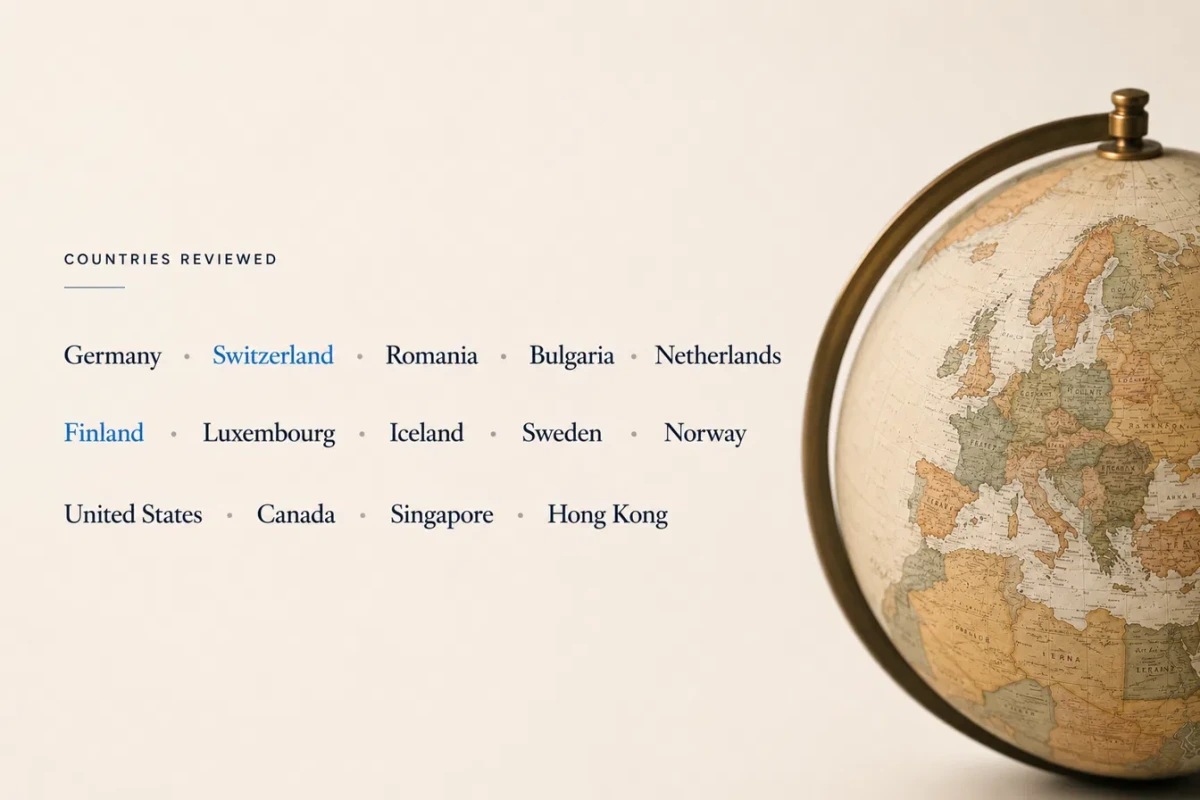
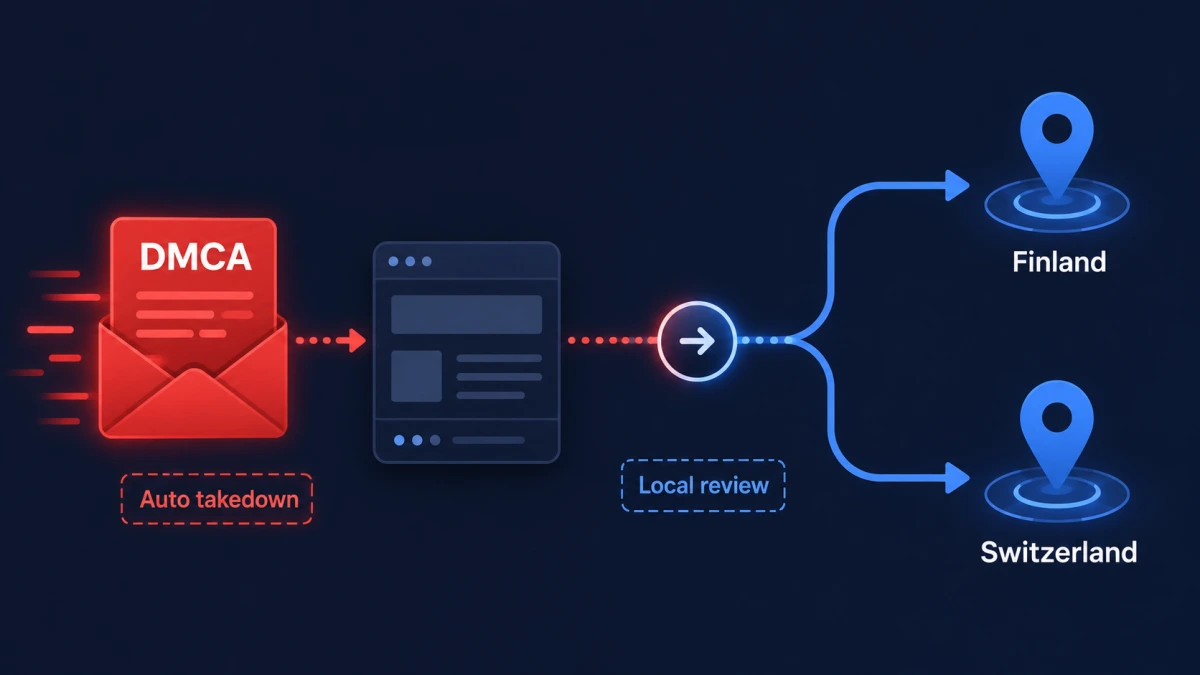
Where we are genuinely competitive is price on the extensions that matter for this audience: .ch at €15.90, .li at €12.00, .com at €17.90, all with transfer priced identically to registration. If you read our domain seizure guide and concluded you want a Swiss-registry name, that combination is hard to beat.
Where we are not the answer: we are new, launched in January 2026, and we have no twenty-year record of resisting takedown pressure. If longevity is your primary criterion, 1984 has two decades on us and you should weigh that honestly. We do not hold our own ICANN accreditation, so on question four we are one more link in the chain rather than one fewer. And we do not offer the nominee model, so if you need your details off the registrant record entirely rather than merely off the public lookup, Njalla is the product that does that and we are not going to pretend otherwise.
Porkbun and Namecheap
CHEAPEST OWN ACCREDITATION US JURISDICTION
Both mainstream, both cheap, both include free WHOIS privacy on most extensions, and both hold their own ICANN accreditation, which shortens the chain by a company. Crypto is limited: each supports account funding through a third-party payment processor, and neither documents Monero support. Those processors can also apply their own verification at their own discretion regardless of the registrar's policy.
Both are US companies. Everything covered in the domain seizure article about US legal reach applies to them at the registrar level, not merely at the registry. If your reason for wanting privacy is keeping your home address off a spam list, they are fine and you will save money. If your reason involves a jurisdiction, they undo the point.
How to choose
You want your details off the registrant record entirely and can accept holding the name by contract. Njalla. Nothing else here substitutes its own details at the point of registration.
You want privacy plus direct registration, and the provider's longevity matters. 1984 Hosting. Two decades of holding the same position is harder to buy than a feature list.
You want an .is domain, or you want to pay in cash. OrangeWebsite.
You want a Swiss or Liechtenstein registry name at a sensible price with DNS you control. Packetra, and we would say that, so check the .ch and .li pricing against the others before taking our word for it.
You want the shortest possible chain of companies, and jurisdiction is not your concern. Porkbun or Namecheap. Fewer intermediaries is a real advantage, and it is the one thing the privacy field generally cannot match.
You just want your home address off the public WHOIS. Any of them. Do not overpay for a threat model you do not have.
Things none of them can fix
- The extension overrides the seller. Some registries require verified identity and some require residency. Nobody can register around a registry rule, and buying a .eu from the most private service in the world still means satisfying .eu's eligibility test.
- Your hosting is a separate problem. An anonymous domain pointed at a server bought with a named credit card achieves very little. The domain is one layer, covered alongside the others in what anonymous web hosting actually means.
- The renewal is where people get caught. An anonymous registration that auto-renews three years later against a card added for something else links the two permanently. Keep the payment method consistent with the registration.
- Certificates leak identity. A free Let's Encrypt certificate reveals nothing. An organisation-validated or extended-validation certificate publishes your verified legal name in a public log, permanently.
- Cross-posting defeats everything. The most common failure is not technical. It is the anonymous site being shared from an account carrying your real name.
And none of it changes who can take the name away once it exists. That is a function of the registry and its jurisdiction rather than who you bought through, which is the subject of who can actually take your domain away.
Frequently asked questions
Is anonymous domain registration legal?
Yes. For gTLDs, ICANN-accredited registrars do have obligations here: under the Registrar Accreditation Agreement they must collect registrant contact data, validate its format, and verify either the email address or the telephone number within fifteen days of registration, suspending the domain if they get no affirmative response. The Registration Data Policy that took effect on 21 August 2025 sets out what must be collected and what must be published or redacted. None of that is identity-document verification. ICANN does not generally require registrants to submit a passport or government ID, which is why a service can be fully compliant and still never ask who you are. Individual registries may impose stricter requirements of their own.
Is WHOIS privacy enough on its own?
It depends entirely on who you are hiding from. It removes your details from public lookups, which handles spam, scraping and casual curiosity. It does not remove them from the records held by the seller, the accredited registrar or the registry, and they remain disclosable under legal process.
What is the difference between no-KYC and anonymous?
No-KYC means nobody asks you to verify your identity. Anonymous means nobody in the chain holds anything meaningful about you to hand over. Most services marketed as anonymous are no-KYC with unverified contact details on file, which is weaker but usually sufficient.
Does it matter that my registrar is actually a reseller?
It adds a company to the chain and a jurisdiction to consider, and it means your contract is with someone who is not the party ICANN holds accountable. For most people it is not decisive, but it should be a known fact rather than a surprise, and it is one WHOIS lookup away.
Does paying in Monero make my domain anonymous?
It removes the financial paper trail, which is one of the main ways registrations get linked to people. It does nothing about the contact details on the registration, the IP you signed up from, or the hosting behind the name.
Can I transfer an existing domain to a more private provider?
Yes, the standard transfer process works between any two registrars. Bear in mind the details already given to the old one stay with them after the transfer, so this improves your position going forward rather than erasing history.