
How to DirectAdmin – Forwarders

Contents

    This article applies only to Packetra account holders. It assumes you already logged into DirectAdmin. Don’t have a hosting account yet? Check out our Shared Hosting or WordPress Hosting. Already have one? Log in to your portal. Click the DirectAdmin hosting service, then click the “Log in to DirectAdmin” button on the content page to follow the guide below.

    Find the Forwarders Section

    First, open the E-Mail Manager dropdown in the Control Panel navigation. Select the Forwarders button. This way, you can either add or remove an forwarder types. Once you are on the page you simply click the +Create E-mail Forwarders button.
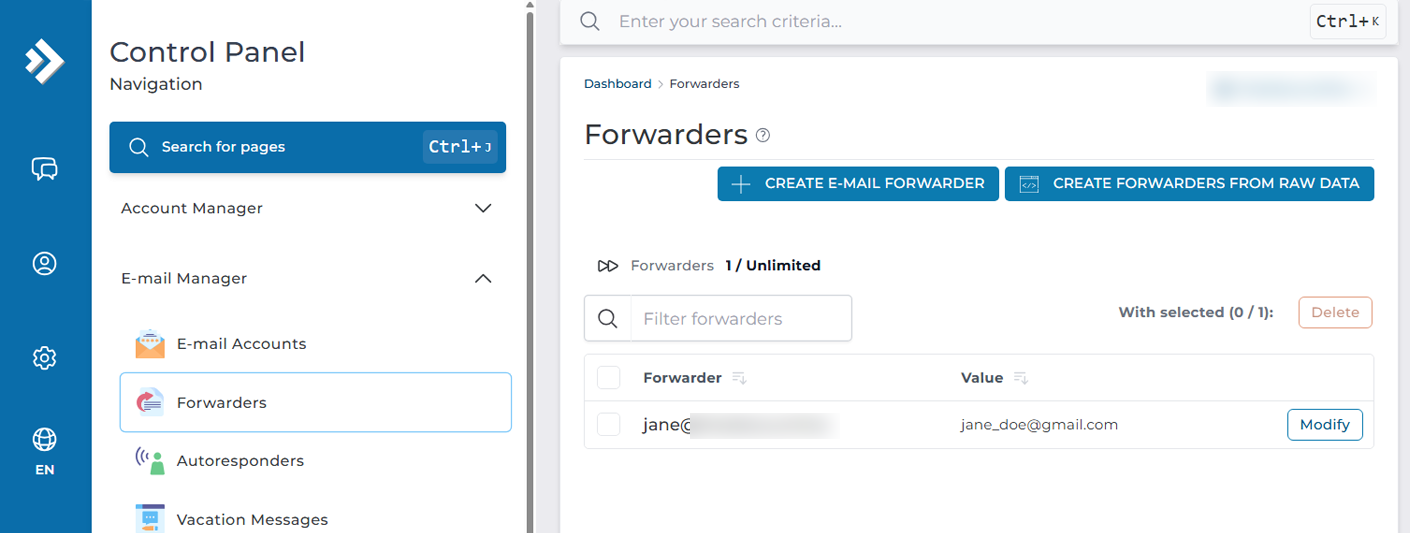
    Forwarders main screen

    Create Forwarders

    Next, on this page you will fill in the information required for each forward type, there are 4 different forwarder types, one is E-mail forwarder, one is Pipe, and then there are two forwarders called :blackhole and :fail. We will start with the Email Forwarder.

    Email Forwarder

    You will fill in the required information for the forwarder such as “New Forwarder Name” and “Add Destination”. You put in the first one the email you wish to forwarde, and then in the second field where you wish to forward it. In my example joe@example will be forwarded to [email protected], so that when someone sends to my [email protected] my GMAIL will receive it.
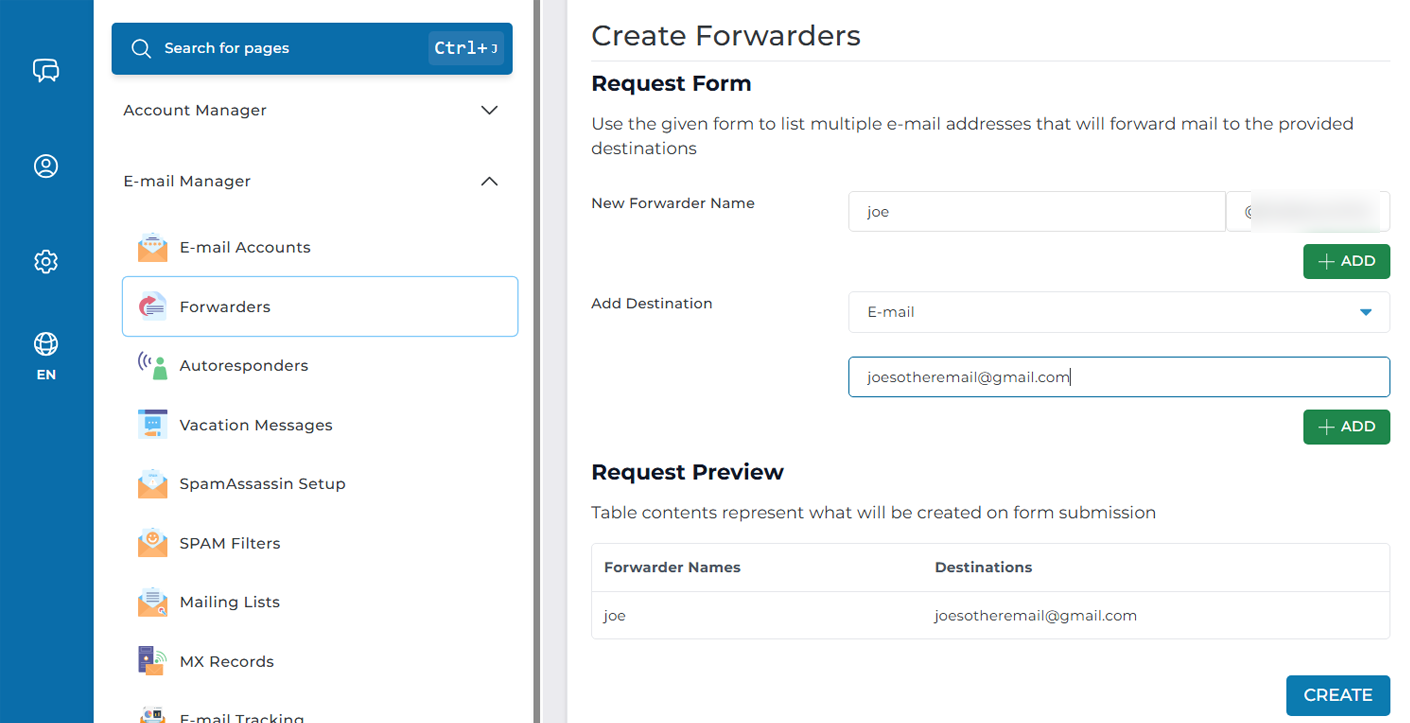
    Create forwarders of 4 different types such as Email, Pipe, Blackhole and Fail.

    Pipe Forwarder

    You will start by filling in the forwarder name, just like in the sample above, in my example I will use “support@example”, then in the destination, we select from the drop down “Pipe”.

    What this allows us to do is forward the incoming email content into a pipe, this can be a script pipe such as .php file which handles the incoming data and parses it. In my destination I put for this sample |/usr/bin/php -q /home/yourdomain/public_html/crons/pipe.php and what that does is send the email content to this pipe.php script.

    In this example, that script is part of WHMCS which would allow emails sent to be piped to a built ticket board that comes with the billing software. This is of course just one use, there are multiple use cases for a pipe.
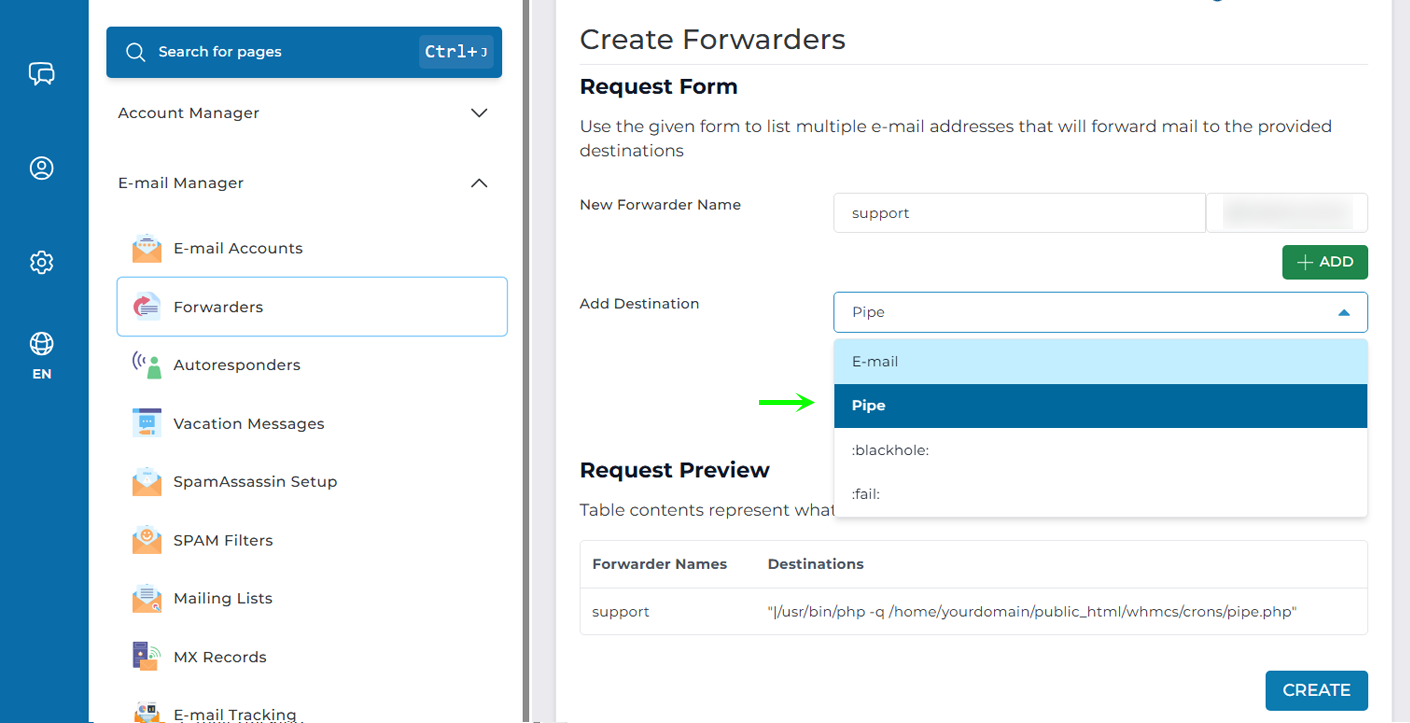
    Forwarder being created with pipe as the example

    Blackhole and Fail Forwarders

    The last two types are :blackhole: and :fail: – blackhole silently discards emails while fail returns a bounce to sender.

    Frequently Asked Questions

    What’s the difference between a forwarder and a pipe?
    A regular forwarder sends incoming mail to another email address, such as a Gmail inbox. A pipe sends the mail into a script instead, so a program can process it. Use a pipe when you want software, not a person, to handle the message.

    What can I actually use a pipe for?
    The common case is a helpdesk. You pipe an address like [email protected] into a script, and each email becomes a support ticket automatically. WHMCS works this way with its built-in ticket system. However, a pipe can feed any script you write, so the uses go well beyond tickets.

    What’s the difference between :blackhole: and :fail:?

    Both stop the mail from reaching an inbox, but they act differently. Blackhole accepts the message and silently discards it, so the sender hears nothing back. Fail rejects the message and sends a bounce notice instead, so the sender knows it didn’t get through.

    Good to Know
    Pipe forwarders open up a lot of automation, but they need the correct full command or DirectAdmin won’t save them. Remember the “Empty pipes are not allowed” warning, so always include the path to your script, such as the PHP binary followed by the script location. Keep in mind that the script must exist and have the right permissions, otherwise the mail has nowhere to go. If you only want to quietly drop unwanted mail, reach for :blackhole:, and if you’d rather the sender get a bounce, use :fail: instead. Run into any issues? Open a support ticket through the client portal and our team will help you.

    Updated on July 2, 2026
    Was this article helpful?