Shared Hosting
  WordPress Hosting
  Cloud VPS Hosting
  Dedicated Servers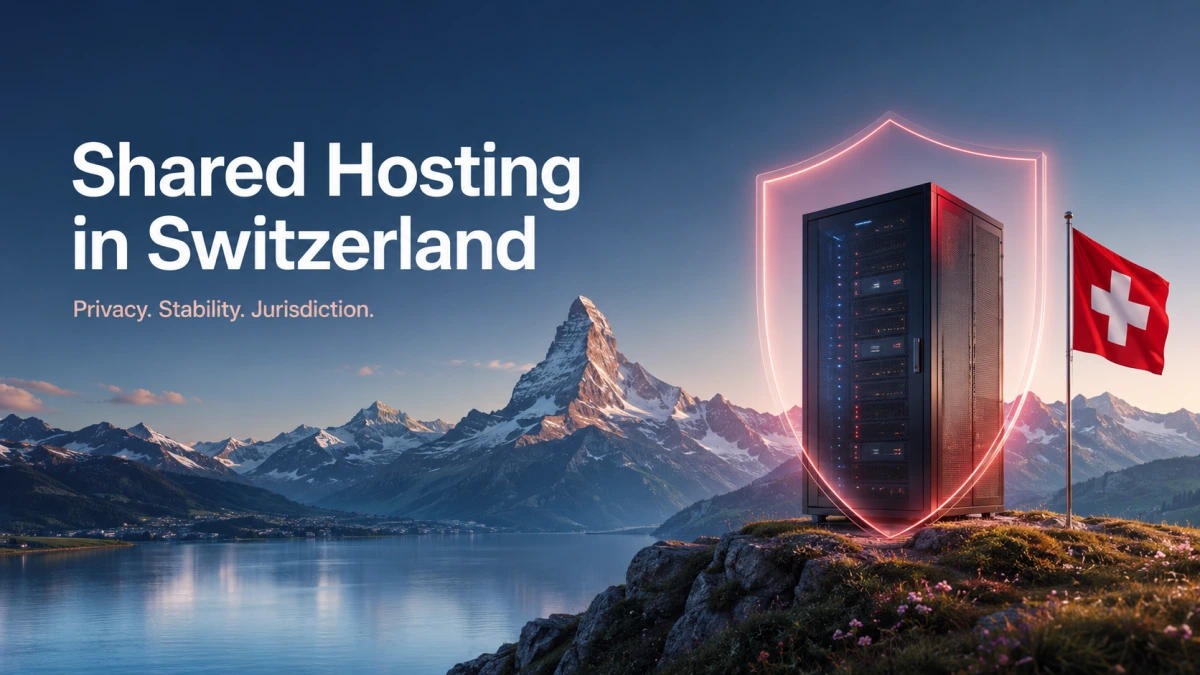
Shared hosting in Switzerland has become a quiet trend among American site owners, and the reasons are more practical than ideological. A blog, a small business site, or a portfolio does not need a server in the same country as its audience. It needs to load fast, stay online, and sit with a host whose legal environment works in the owner's favor. On that last point, Switzerland has advantages a US host cannot offer at any price.
This guide covers what actually changes when your website lives on Swiss shared hosting instead of an American host, what it costs, what the trade-offs are, and who should and should not make the move.
What Changes: Jurisdiction
When your site is hosted in the United States, everything on it sits under US law: subpoenas, court orders, and the takedown machinery built around the DMCA. Hosting in Switzerland moves the server, and the data on it, under Swiss law instead. Requests concerning your data go through Swiss legal process, decided by Swiss courts under Swiss standards.
That is not a loophole and it is not lawlessness. Illegal content is illegal in Switzerland too. What changes is the bar and the process: a foreign demand does not act directly on a Swiss server the way a domestic one acts on a US host. For an ordinary site owner, the practical effect shows up most clearly in one place, which deserves its own section.
The DMCA Difference
Every US host operates inside the DMCA's notice-and-takedown system, and the economics push them toward taking content down first and asking questions later. A competitor or a bad-faith complainant can file a notice and watch your page disappear while you fight to restore it.
A Swiss host is not a DMCA agent. Copyright complaints still exist, but they arrive as ordinary legal matters rather than automated takedown triggers, which removes the hair-trigger dynamic entirely. The full mechanics of this are covered in DMCA Takedowns and Hosting Jurisdiction. For anyone who has ever lost a page to a bogus notice, this alone justifies the move.
The Privacy Layer
Switzerland's data protection framework, the revised Federal Act on Data Protection in force since 2023, is one of the strictest outside the EU, and Switzerland itself sits outside both EU data-sharing structures and US jurisdiction. Your hosting account and your visitors' data live under those rules.
Americans already trust this instinctively: Swiss banks, Swiss neutrality, and Swiss-based services like encrypted email providers built their reputations on exactly this legal foundation. Hosting simply applies the same logic to your website. How far that protection extends, and where it stops, follows the same honest rules as any privacy tool; Anonymous Hosting: What It Really Means in 2026 draws those lines properly.
Speed: The Honest Answer
A server in Switzerland is roughly 100 milliseconds from the US East Coast. For a static-ish website, a blog, or a business site with normal traffic, that difference is invisible in practice: modern shared hosting with SSD storage, HTTP/2, and basic caching delivers Swiss-hosted pages to American visitors without anyone noticing where the server is. Add a CDN for your images and it disappears entirely.
Where it genuinely matters is real-time applications, gaming, or latency-sensitive tools, and those do not belong on shared hosting anywhere. For the sites shared hosting is built for, geography stopped being a speed problem years ago.
What Shared Hosting in Switzerland Costs
Here is the part that surprises people. Offshore and privacy hosting built its reputation in expensive jurisdictions, and the famous names price accordingly, often several times the cost of mainstream US hosting for a basic shared plan. Shared hosting in Switzerland does not have to work that way: entry plans exist from around €5 per month, in line with what Americans already pay domestic hosts, with the jurisdiction benefits included rather than sold at a premium.
The features are the ones you already expect: free SSL, one-click installers for WordPress and other software, site builders, regular backups, and a money-back window to test it risk-free. Payment works with a normal credit card or PayPal; cryptocurrency is an option for those who want it, not a requirement.
Who This Is For
The best fit for shared hosting in Switzerland is the ordinary site owner with a reason to care where their data lives: bloggers and writers who publish opinions, small businesses tired of takedown-happy platforms, professionals who promised clients confidentiality, and anyone who simply prefers their website outside the reach of US legal machinery while still running a completely normal, legal site.
It is not for everyone. If your site is a latency-critical application, host near your users. If your project needs root access or heavy resources, you want a VPS rather than shared hosting, and the jurisdiction question for that tier is compared properly in Finland vs Switzerland Hosting in 2026. And if you are expecting Swiss hosting to shield genuinely illegal activity, it will not, and no honest host will tell you otherwise.
Making the Move
Switching a shared-hosted site is mundane: most privacy-focused hosts migrate your files and databases for free, your domain points to new nameservers, and the visible change for your visitors is nothing at all. The invisible change is that your site now answers to Swiss law instead of a US takedown queue.
That is the whole case for shared hosting in Switzerland. Not an exotic offshore adventure, just a normal website, normal price, normal features, in a jurisdiction that treats your data better than the one you left.