Shared Hosting
  WordPress Hosting
  Cloud VPS Hosting
  Dedicated Servers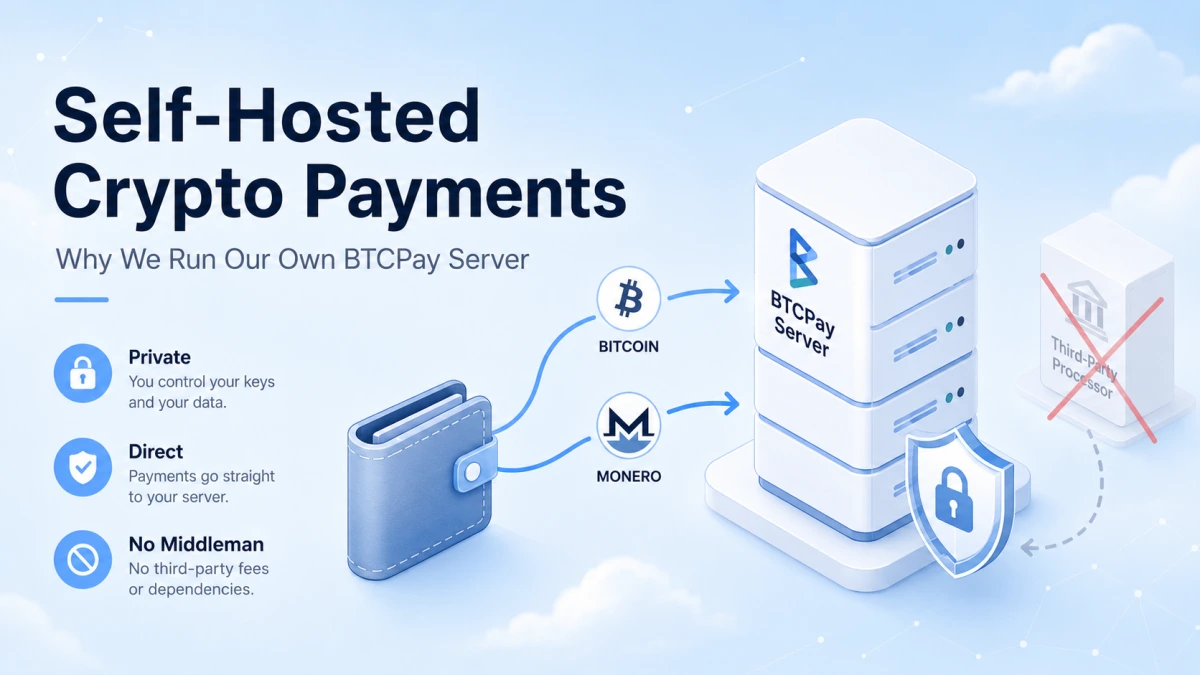
Most hosting companies that say they accept crypto do not actually accept crypto. They accept a receipt for crypto that somebody else collected on their behalf.
That sounds like a small distinction, and for a lot of purchases it does not matter. But hosting is one of the cases where it does. If privacy is part of why you are looking at a provider like us in the first place, it is worth understanding what actually happens when you click “Pay with Bitcoin,” both here and anywhere else.
This guide is about self-hosted crypto payments: the difference between accepting crypto through a third-party processor and accepting it through a server the merchant runs themselves, why we chose the harder of the two for Bitcoin and Monero, and what that choice means for you as a paying customer. It is not a sales page. By the end you should be able to look at any host’s checkout and work out for yourself what kind of crypto payment they are really offering.
The Short Version, If You Only Read One Thing
When you pay a company in Bitcoin or Monero, the coin you send is only half the story. The other half is who receives it.
For Bitcoin and Monero, we run the second kind. The rest of this guide explains why that is not just a technical footnote, and near the end, why the other coins we accept work a little differently.
What a Payment Processor Actually Does
When you buy something online with a card, a chain of companies you never see makes it work: the gateway, the acquiring bank, the card network, the issuing bank. They authorize the charge, move the money, and take a cut. You never think about them because the system is mature and mostly invisible.
Crypto payments need a similar set of jobs done, even though there is no card network involved. Specifically, something has to:
- generate a unique payment address or invoice for your order
- show you the right amount and hold the exchange rate steady long enough to pay
- watch the blockchain to confirm your payment actually arrived
- mark the order as paid and tell the store to provision your service
- optionally convert the crypto into regular currency so the merchant avoids price swings
A crypto payment processor is simply the thing that does those jobs. The entire question in this guide is: who is the “thing”? A separate company you have to trust, or software the merchant runs themselves?
The Third-Party Model, and the Quiet Trade-Offs
The third-party model is popular for an obvious reason: it is easy. A merchant signs up, pastes an API key into their store, and crypto checkout works that afternoon. The processor handles wallets, confirmations, conversion, and refunds. For a business that just wants to tick the “we take crypto” box, it is the easy route.
But that convenience comes from handing those jobs to an outside company, and that company has its own interests, rules, and obligations. Here is what that quietly introduces.
A third party sees every transaction. The processor, not the merchant, generates the address and records the payment. Even if the merchant collects nothing about you, the processor has a record of who paid what to whom, and that record lives under their data-retention policy, not the merchant’s.
Identity verification creeps in. Custodial processors are increasingly regulated like financial institutions, which pushes them toward KYC checks, transaction monitoring, and the power to freeze accounts. Those checks often kick in above a spending threshold, sometimes from the first payment. So you can be paying a “no-KYC” merchant and still be asked to verify your identity, because the processor requires it. The privacy promise on the merchant’s homepage does not extend to a company they outsourced the money to.
Payments can be held, refused, or reversed. Processors operate under their own compliance regimes and can freeze or decline transactions that trip their rules. That means your payment is subject to a policy you never agreed to and usually cannot read.
Privacy-coin support is often shallow or absent. Many mainstream processors do not support Monero at all, because its privacy properties are exactly what their compliance teams want to avoid. So a host can advertise crypto payments while quietly not supporting the one coin a privacy-focused buyer would actually want to use.
None of this makes third-party processors evil. For a mainstream store selling sneakers, they are a perfectly reasonable choice. The point is narrower: if you are choosing a host specifically for privacy and data ownership, a third-party processor silently undercuts the very thing you came for. The coin in your wallet might be private; the pipe you send it through is not.
What Self-Hosted Crypto Payments Actually Involve
BTCPay Server is free, open-source software that lets a merchant be their own payment processor. Instead of renting the jobs above from an outside company, the merchant runs the software themselves, on their own server, connected to their own wallet. That is what “self-hosted” means here: the processing happens on infrastructure the merchant controls, not on someone else’s platform.
A few properties make it meaningfully different, not just cosmetically different:
- It is self-hosted. The software runs on infrastructure the merchant controls. There is no BTCPay company sitting between you and the merchant. The project that writes the software never touches your payment, the same way the people who write a web browser never see the sites you visit.
- It is non-custodial. Payments go straight to the merchant’s own wallet. The funds are never held by a middleman who could freeze, lose, or be compelled to hand them over. Wallet to wallet, you to us.
- It is open-source. Anyone can inspect exactly what it does. There is no proprietary black box deciding what happens to your payment.
- It collects no third-party identity. Because there is no outside processor, there is no outside KYC form, no separate account to create, and no extra company building a profile around your transaction.
- Each invoice uses a fresh address. Addresses are not reused between orders, which keeps your payments from being trivially linked together on the blockchain.
Put simply, self-hosted crypto payments turn “we accept crypto” back into something close to its original promise: a direct payment between two parties, with no financial company in the middle.
Why We Chose the Harder Option
We will be honest about this: self-hosting a payment processor is more work than pasting in an API key. We run the server, we maintain it, we keep the wallet infrastructure healthy, and we own the problems when something needs attention. The third-party route would have been faster and lower-effort for us.
We chose BTCPay anyway because the alternative would have quietly contradicted everything else we do. We offer email-only signup, we do not run KYC, and we built the business around the idea that you should not have to hand over a pile of personal information to rent a server. Bolting a third-party processor onto that checkout (one that does log transactions and might demand ID) would have undercut the whole point. You would have had privacy everywhere except the one moment money changes hands, which is exactly the moment most people care about.
So the decision was less “BTCPay is a nice feature” and more “any other choice would make our privacy claims dishonest.” For Bitcoin and Monero, we run our own self-hosted BTCPay Server, and those payments go directly to us with no third-party processor in between.
A Note on Other Coins: Where CoinPayments Fits
We want to be straight with you about one thing, because it is exactly the kind of detail this guide is teaching you to look for.
Bitcoin and Monero run through our self-hosted BTCPay Server, with no middleman. But we also accept a wider range of cryptocurrencies, and those do go through a third-party processor (CoinPayments), alongside the usual conventional payment methods. We are not going to pretend otherwise just because it makes a cleaner story.
The reason for the split is practical. Self-hosting every possible coin is a lot of infrastructure to run safely, so we self-host the two that matter most to privacy-focused customers (Bitcoin and, especially, Monero) and use a processor for the other, less-common coins where the convenience is worth it. If maximum privacy is your priority, the takeaway is simple: pay in Bitcoin or Monero, and your payment stays on the self-hosted, no-middleman path. If you would rather pay in another coin and the third-party route is acceptable to you, that option is there too. The choice, and the trade-off, is yours to make with full information.
What This Means for You at Checkout
Here is the practical, on-the-ground difference when you pay us in Bitcoin or Monero:
- No third-party account. You are not bounced to a processor’s site, you do not create a login somewhere else, and you do not agree to a separate company’s terms.
- No processor-side identity collection. There is no KYC gate sitting between your wallet and our invoice. We do not run KYC ourselves either, but the point here is that there is no outside party adding one back in.
- Your payment is not logged or resold by a middleman. The transaction is between your wallet and ours, with no intermediary keeping a record under its own data-retention policy.
- Monero is genuinely supported. Not as an afterthought, but as a real payment option we run ourselves. It is not something we had to drop because a processor refused to touch it.
The Honest Trade-Offs
A guide that only listed upsides would not be worth your time, so here are the real costs of doing it this way.
Confirmations take a little time. Crypto payments are not instant the way a card swipe feels instant. The network needs to confirm the transaction before we mark the order paid. For Bitcoin that is usually minutes: normal, not a problem, but not zero.
Refunds work differently. With cards, refunds are a well-worn, automatic process. With direct crypto, a refund is a new payment going the other way, and the amount question matters: do you get back the exact coin amount you sent, the fiat value at the time of purchase, or the fiat value at the time of refund? These are not the same number if the price moved. Monero payments in particular are irreversible, so we handle refunds deliberately, case by case, and it is worth asking about before you pay if you anticipate needing one.
Price volatility is real. The value of what you send can move between when you pay and when it settles. This is a property of crypto itself, not of how we process it, and it is less of an issue with stablecoins than with Bitcoin.
We mention these not to talk you out of paying with crypto, but because a host that pretends crypto payments are flawless is a host that has not thought about them carefully. We would rather you go in with clear eyes.
How to Read Any Host’s Crypto Checkout
The most useful thing you can take from this guide is a quick test you can run on any provider, not just us. Next time a host advertises crypto payments, ask:
- Who generates the payment address? If you get redirected to a different company’s domain to pay, that company is the processor, and it is in the middle of your transaction.
- Do they support Monero, or only Bitcoin and “major coins”? Real Monero support is a strong signal that they are not leaning entirely on a compliance-driven third party that refuses it.
- Is there a KYC step, especially above a threshold? If so, find out who is requiring it: the merchant or the processor. Either way, your payment is not as private as the marketing implies.
- Do they say “self-hosted” or “non-custodial,” or do they name a processor? Naming a third-party processor is honest, but it tells you one is involved. “Self-hosted BTCPay” or “direct, non-custodial” tells you the opposite. A host that uses both (self-hosted for the privacy coins, a processor for the rest) should be able to tell you exactly which is which.
You do not have to take anyone’s word, including ours. The checkout flow itself answers most of these questions if you watch what it does.
Here is what it looks like in practice. A self-hosted BTCPay flow shows you an invoice generated by the merchant’s own payment server, on the merchant’s domain, with a fresh address for your order. If you are instead redirected to a processor-branded payment page, that processor is part of the transaction, and everything in the third-party column above applies to your payment.
The Bottom Line
“Accepts crypto” is not a single thing. It is a spectrum that runs from “we outsourced it to a company that logs everything and might ask for your ID” to “the payment goes straight from your wallet to ours and no one else is involved.” The coin you choose matters, but the plumbing behind the checkout matters just as much, and it is the part almost nobody explains.
We run our own BTCPay Server for Bitcoin and Monero because, for a privacy-focused host, anything less would be a contradiction. Pay us in one of those two and your payment goes directly to us, with no middleman holding the funds, watching the transaction, or quietly attaching a KYC form. Other coins take the more conventional route through a processor, and now you know the difference: here, and at any host you evaluate from now on.
For the bigger picture on what a privacy-focused VPS can and cannot do for you, see our anonymous VPS guide and our explainer on hosting with Monero. And for why jurisdiction matters as much as payment method, read Finland vs. Switzerland for privacy hosting.