Shared Hosting
  WordPress Hosting
  Cloud VPS Hosting
  Dedicated Servers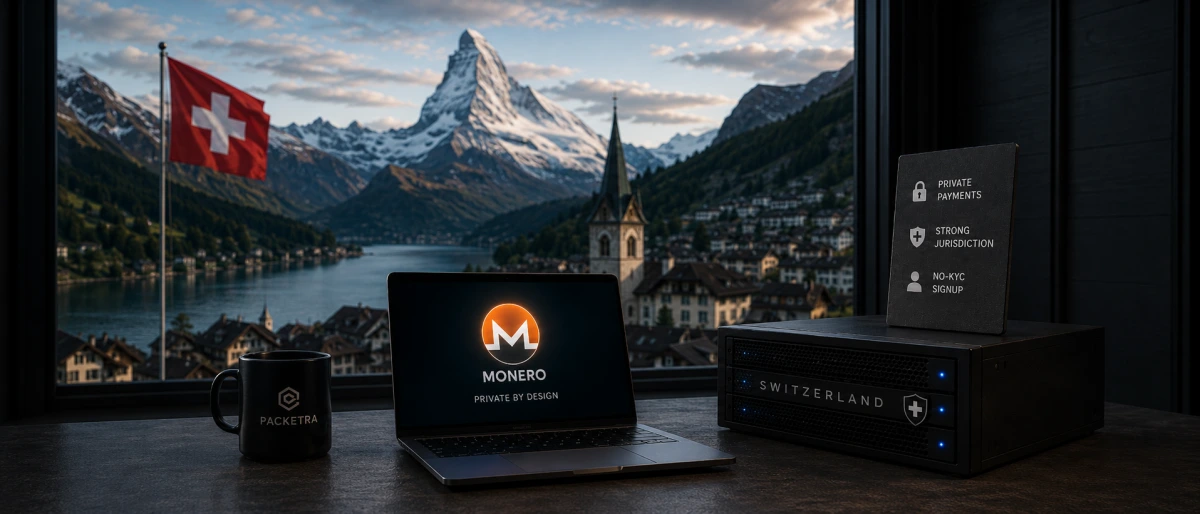
Monero hosting in Switzerland comes up constantly in privacy circles, and it is not a coincidence: Monero as a payment method and Switzerland as a location each solve a different part of the same problem, and combined they cover more of it than either does alone.
What follows is a practical look at what Monero hosting in Switzerland actually gives you, where the real advantages sit, and where the limits are.
Switzerland's data protection is governed by the Federal Act on Data Protection (FADP), one of the strongest privacy frameworks in Europe. Unlike EU member states, Switzerland sits outside GDPR jurisdiction while maintaining comparable protections, giving hosting clients a legal environment built around privacy rather than surveillance.
Why Switzerland and Monero Get Paired
Monero addresses privacy at the moment of payment. Switzerland addresses privacy at the level of jurisdiction: where the server physically sits, and whose laws govern requests for the data on it. These are separate layers. A transaction can be private while the hosting sits in a jurisdiction that logs heavily and cooperates broadly, and a server can sit in a strong jurisdiction while the payment method exposes the buyer completely. Pairing them closes both gaps at once, which is why Monero hosting in Switzerland keeps appearing as a combined recommendation rather than two separate ones.
For a fuller treatment of the payment side on its own, see Anonymous Hosting with Monero. This article focuses on what the Swiss side adds on top of it.
What the Swiss Jurisdiction Actually Offers
Switzerland's reputation for privacy is often explained badly. It is not about banking secrecy, which is a financial-sector rule that has nothing to do with the data on a web server. The relevant framework is the revised Federal Act on Data Protection (the nFADP), which came into force in September 2023 and sets strict rules on consent, transparency, and how personal data is handled.
Two structural points matter more than the marketing usually admits. First, Switzerland sits outside the European Union, so it is not bound by EU data-sharing arrangements in the same way member states are. Second, it sits outside United States jurisdiction, which means laws like the US CLOUD Act do not reach data held by a genuinely Swiss-operated service the way they reach US-based companies. For data that is physically located in Switzerland and controlled under Swiss law, access by third parties runs through Swiss legal process rather than foreign demands.
Switzerland also has a long tradition of political neutrality and a stable, independent judiciary. None of this makes data untouchable, and any honest description should say so. What it does is raise the bar: requests follow a defined legal path rather than an informal one, and the country is not obligated to blanket-retain user data on behalf of a foreign government.
What Monero Adds That Other Crypto Does Not
Accepting cryptocurrency and accepting Monero are not the same claim. Most cryptocurrencies run on transparent ledgers where addresses and transfers can be observed and, with effort, traced. That is acceptable for some purchases and a poor fit for others. Monero is built so that privacy is part of the transaction model itself, which means the payment reveals less by design rather than by policy.
For a hosting purchase, that difference is concrete. A buyer who does not want a server payment linked to their broader financial identity gets a materially cleaner path with Monero than with a transparent-chain coin or a bank-linked method. The strongest setups process Monero through a self-hosted payment system rather than a third-party processor, so the payment data is not routed through an outside company that keeps its own records. Providers running their own self-hosted BTCPay Server fall into this category.
The Role of No-KYC Signup
Payment privacy and jurisdiction do a lot, but they can be undone at the front door. If opening an account requires a full legal identity, an address, and a phone number, then the privacy story is already weaker before a server is deployed. This is the point many providers quietly skip.
A no-KYC signup, where an email is enough to create an account, keeps the account layer consistent with the payment and jurisdiction layers. It is not about hiding from the law; it is about not collecting information that is not genuinely needed to deliver hosting. When no-KYC signup, Monero payment, and Swiss jurisdiction line up together, each one reinforces the others instead of leaving a weak link. The broader logic behind this is covered in Anonymous Hosting: What It Really Means in 2026.
What Monero Hosting in Switzerland Does Not Solve
Serious privacy writing has to be honest about limits, and this is where most marketing changes the subject. Monero hosting in Switzerland reduces exposure. It does not make anyone invisible.
Swiss jurisdiction does not place data beyond all legal reach; it routes access through Swiss legal process. Monero does not protect a buyer who reveals their identity elsewhere, reuses the same email across services, or exposes themselves through the content of the project itself. No-KYC signup does not help someone who then publishes their own ownership details. The privacy of the payment and the strength of the jurisdiction are real, but they only cover the layers they cover. Operational security still sits with the user.
That is not a reason to dismiss the combination. It is the reason to describe it accurately: a meaningful reduction in unnecessary exposure, not a guarantee of anonymity.
Switzerland or Somewhere Else in Europe
Switzerland is not the only strong option, and it is worth knowing when it is the right one. It tends to suit buyers who specifically want a non-EU jurisdiction with a strong independent data protection regime and a neutral political posture. Other European locations, including Finland, offer their own advantages within the EU framework, and for some projects that is preferable.
The trade-offs between the two most commonly compared privacy locations are laid out in Finland vs Switzerland Hosting in 2026. For buyers still choosing a provider rather than a country, Best Privacy Hosting Providers in 2026 adds another layer of context.
A Realistic Summary
Monero hosting in Switzerland works because it stacks three separate privacy decisions that are usually treated in isolation. The payment is private by design. The jurisdiction is strong, non-EU, and outside US legal reach. The signup does not demand identity that is not needed. Each layer is limited on its own, and each becomes more effective when combined with the others.
It will not make a careless operator safe, and it was never meant to. What it removes is the exposure that comes standard with an ordinary hosting purchase: the identity demanded at signup, the bank trail attached to the payment, and the foreign legal reach over the server itself. That is a narrower promise than most providers make, and a far more useful one.